Didn’t find the necessary information? Make an appointment for a consultation with oral surgeon Ihor Oleksandrovych Osadchy.
Acrylic Dentures
Micro-prostheses, removable and partially removable acrylic dentures remain quite popular in modern dentistry. The vast majority of clinics in Kyiv offer acrylic prosthetic services. However, the popularity of a particular technology is not a sufficient reason for its application. Therefore, we recommend learning about the features, advantages, disadvantages, and medical indications for acrylic denture installation.
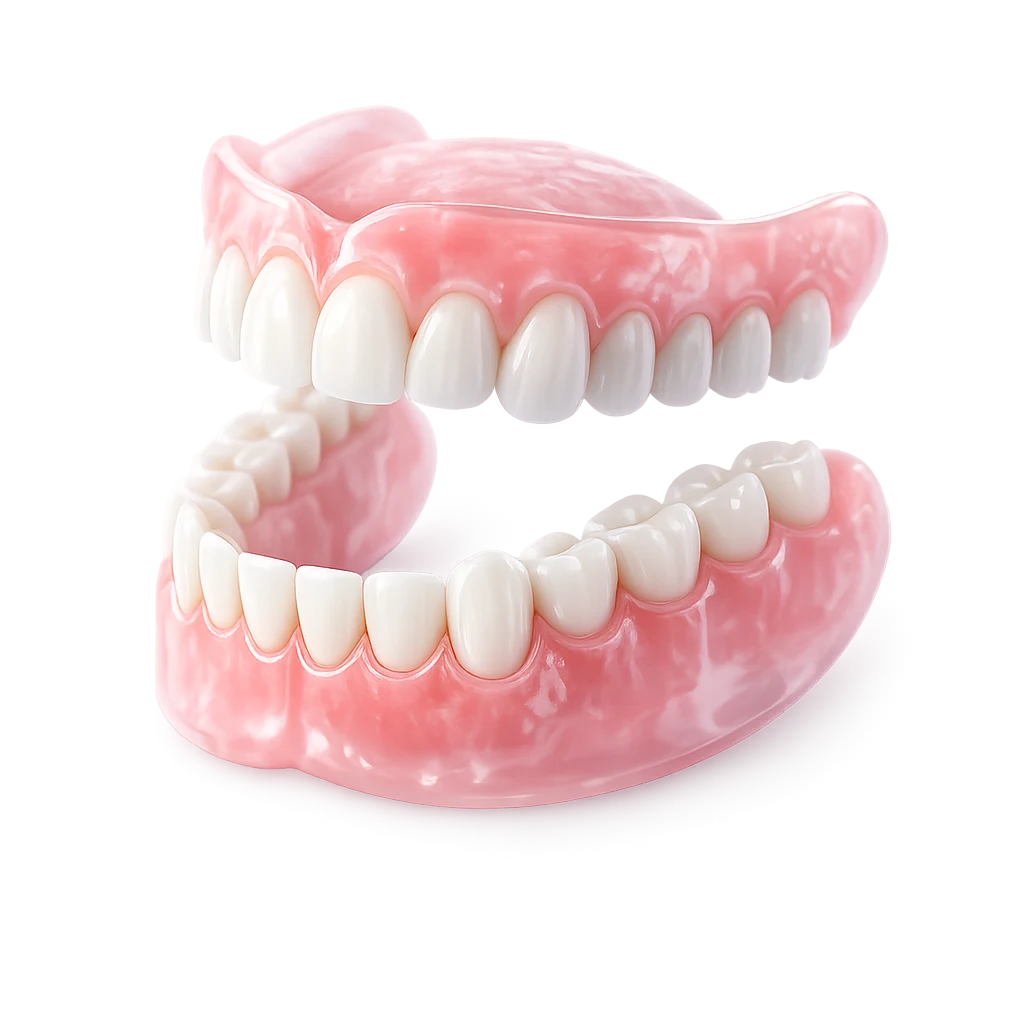

The use of acrylic dentures falls under removable prosthetics and involves the fabrication of a removable structure that imitates the mucosa and teeth. In some cases, acrylic dentures can also be non-removable (if they are placed on implants).
With a slight stretch, it can be said that acrylic dentures appeared at the end of the 19th century. German dentist Karl Lande created a removable denture made from a material close to modern acrylic. However, acrylic dentures became widely used only in the 20th century — after the emergence of plastic materials.
Acrylic dentures, unlike clasp prostheses, are made from lightweight and comfortable-to-wear materials. They exert less pressure on the oral mucosa and contribute significantly less to bone thinning.
The production of dentures is based on the use of certain types of acrylic plastics. However, to achieve all dental goals, one material is not enough, so a combination is used:
- Polymethyl methacrylate (PMMA) — used as the primary material.
- Acrylic resins — used to enhance the strength of the denture and achieve the desired color.
- Pigments — used to obtain the desired color of artificial teeth that would resemble the patient’s natural teeth.
- Other additives — in some cases, metal inserts may be needed to give the denture an anatomically correct shape.

Extensive experience
Стаж работы челюстно-лицевой хирурга 38 лет, из них 8 лет — работа дежурным врачом отделения острой травмы.

Number of surgeries
Over 2,000 successful surgeries in the field of maxillofacial surgery.

Quality of work
Thanks to a thorough approach in diagnostics and treatment planning for each clinical case, we achieve a minimal number of complications.
An acrylic denture differs from a clasp prosthesis in that it can be installed to replace both a portion of lost natural teeth and all of the patient’s teeth (on an edentulous jaw).
Types of Acrylic Dentures
| Denture Type | Description |
| Full acrylic dentures | Fully imitate the mucosa and dental arch of the upper and lower jaws. Full removable acrylic dentures are used when the patient has no teeth |
| Partial acrylic dentures | Used when it is necessary to restore some of the patient’s lost teeth. The design of partial dentures is similar to full acrylic dentures but also has attachments for fixation on the patient’s own teeth |
| Temporary acrylic dentures | Used not for permanent prosthetics but to preserve aesthetics during implant-based prosthetics. When implant abutments are installed and sutured, but the load cannot yet be applied and the crown cannot be placed |
| Butterfly denture or acrylic micro-prosthesis | Imitates a single lost tooth, like partial acrylic dentures, and attaches to adjacent natural teeth of the patient |

A partial removable acrylic denture on the upper jaw can be made without a palate, in which case it will be additionally fixed using hooks on the patient’s own teeth.
For better fixation of full acrylic dentures, special pastes and adhesives are used: carboxymethylcellulose-based, silicone, acrylic, or powder adhesives.
Yes, one of the disadvantages of acrylic dentures is that they can change color over time. There can be several reasons for this: pigments contained in food, the influence of bad habits, improper care of the denture, or natural wear. If the color of the acrylic denture changes, you should consult a dentist.
If such a denture is placed on a front tooth for temporary prosthetics and is out of occlusion, then applying chewing load to it is not recommended. However, if the denture is installed permanently, it can fully perform the chewing function. Of course, with understandable limitations: you should not try to crack nuts or other very hard food with it.
Compared to other types of prosthetics, acrylic is the least long-lasting. On average, acrylic dentures serve up to three years, and with good care — up to five years.
Our clinic specialists do not recommend using acrylic dentures for permanent wear. Removable dentures are always very uncomfortable, fall short in aesthetic performance, and require constant adjustment. Acrylic dentures can be used as a temporary measure or when there are direct medical contraindications for implant-based prosthetics.
Acrylic dentures may be installed under the following medical indications:
- complete and partial loss of natural teeth;
- the need for temporary prosthetics during two-stage implant installation;
- rehabilitation after surgical intervention;
- impossibility of using other types of prosthetics (implantation).
Acrylic dental prosthetics has a number of medical contraindications:
- mucosal diseases (periodontitis, parodontitis, etc.);
- allergy to acrylic and other prosthetic materials;
- anatomical features (deformation or resorption (volume reduction) of the jaw bone).
- Relatively low cost of acrylic dentures (compared to clasp prostheses)
- Lighter weight (compared to clasp prostheses)
- Higher aesthetic performance (compared to clasp prostheses)
- Versatility (can be used as a temporary measure to replace one, several, or all teeth)
- Low wear resistance (loses color over time)
- Less durability
- Need for constant adjustment to maintain proper fit
- Effect on food taste
Acrylic and other types of dentures have virtually no advantages compared to implant-based prosthetics. Only implant-based prosthetics allows achieving a result where artificial teeth feel like the patient’s own and look even better than natural ones.
Acrylic dentures can also be installed on implants. If a patient has no natural teeth at all, a removable acrylic denture can be placed on the lower jaw on two implants. They will serve as supports onto which the denture snaps.
Implant-based prosthetics of the upper jaw is impossible using only two units. The minimum required number of implants for upper jaw prosthetics is 4. In this case, it involves creating a non-removable dental prosthesis.
Acrylic dentures are fabricated in a dental laboratory using impressions taken by a dentist.
Before installing an acrylic denture, it is necessary to perform oral sanitation and, if needed, treat teeth and mucosa.
Prosthetic stages:
- taking impressions;
- fabricating the model;
- fitting the denture (if necessary);
- adjustment and installation of the denture.
An acrylic denture requires thorough care. The denture must be cleaned after every meal — you can use a soft or special toothbrush. It is not advisable to use regular toothpaste as it may damage the denture — it is better to use special cleaning agents. Once a week, the denture should be placed in a disinfecting solution.
Acrylic dentures should not be rinsed in very hot water, as this may cause material deformation. It is also important not to forget about scheduled dental visits for adjustment and fitting of the denture, usually every 6–12 months.
In most clinics in Ukraine and Kyiv, price is named among the key advantages of removable acrylic dentures. And indeed, the cost of acrylic dentures is lower than, for example, clasp prostheses. However, the final price for patients may vary.
Prices for acrylic dentures can differ and depend on many factors. An acrylic denture for the upper jaw may cost more than one for the lower jaw. This is due to the need for more complex calculations, as the upper jaw denture is made with a palatal section.
The price of an acrylic denture for one tooth in most Kyiv clinics reaches 4,500–5,000 hryvnias. And the price of acrylic dentures for the entire jaw reaches 10,000–14,000 hryvnias.