Didn’t find the necessary information? Make an appointment for a consultation with oral surgeon Ihor Oleksandrovych Osadchy.
Jaw Dislocation Treatment
Jaw dislocation can occur due to a variety of reasons: from falls and accidents to improper lifting of heavy objects. There are different types of jaw dislocations and quite a large number of reduction techniques. Knowing at least the basics about jaw dislocations is essential for everyone, because the problem can arise and there will be no time for thinking and reading materials. In addition, a dislocation can result from a chronic disease that progresses unnoticed, and it is better to diagnose it in advance.
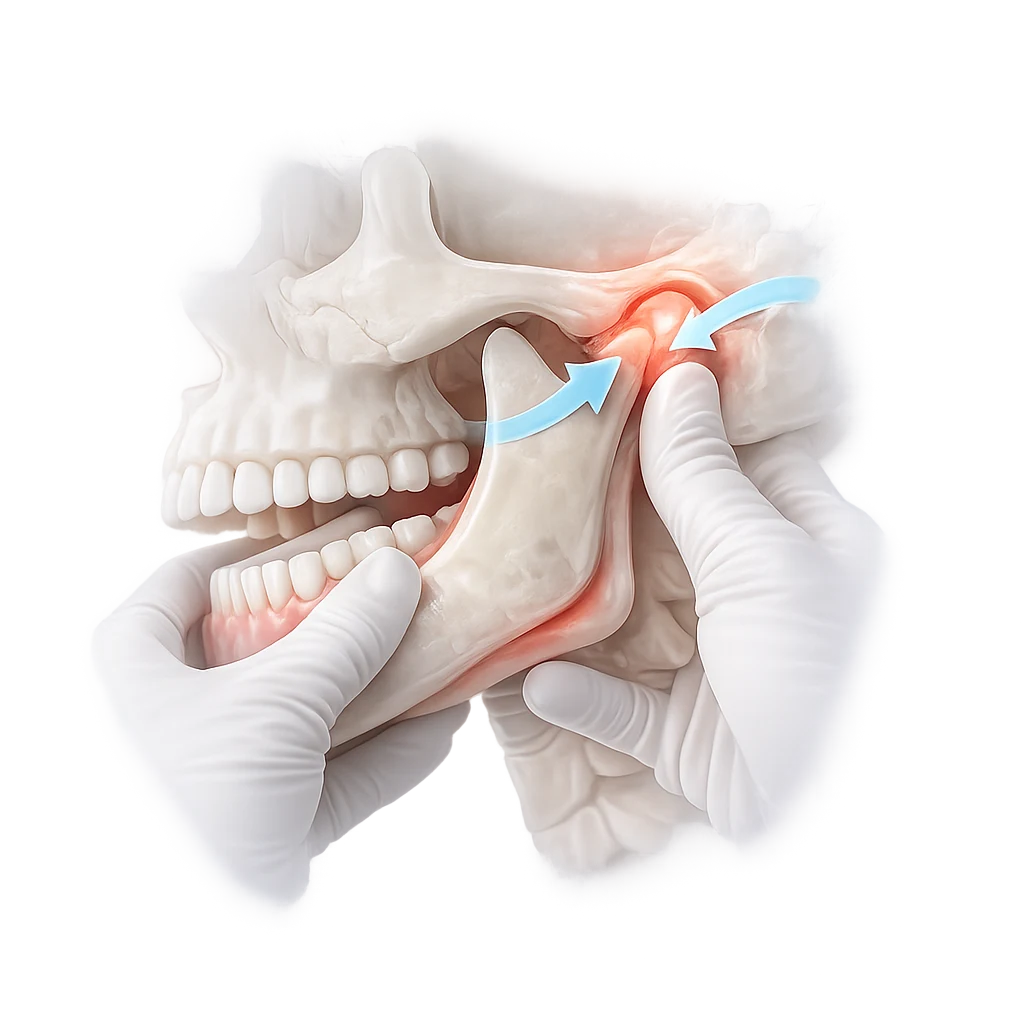

The lower jaw has articular processes on both sides that fit into the articular cavities. These cavities, in turn, are located in the human skull. A lower jaw dislocation occurs when the articular processes “fall out” of the articular cavities. It should be noted that the upper jaw is statically attached to the skull, so an upper jaw dislocation is impossible.
There are a number of circumstances in which a person can get a jaw dislocation, but in most cases it involves mechanical impact:
- accidents accompanied by a strong blow;
- injuries (including sports injuries);
- blows to the jaw area;
- falls;
- birth injuries;
- muscle contractions (for example, during an epileptic seizure);
- joint pathology (for example, arthritis and dysplasia of the temporomandibular joint).
Only a specialist can diagnose and confirm a jaw dislocation, but a person can recognize the need for medical help based on a number of obvious symptoms:
- inability to close the mouth;
- pain;
- jaw displacement and facial distortion (when it is visually apparent that the lower jaw is not in its proper position);
- swelling and bruising;
- difficulty chewing, swallowing, and speaking (including difficulty swallowing saliva);
- clicking (when attempting to move the jaw, clicking or other atypical sounds occur).
The signs of a jaw dislocation are very similar to fracture symptoms. Therefore, in addition to a clinical examination, the doctor may order an X-ray for jaw dislocation.

Extensive experience
Стаж работы челюстно-лицевой хирурга 38 лет, из них 8 лет — работа дежурным врачом отделения острой травмы.

Number of surgeries
Over 2,000 successful surgeries in the field of maxillofacial surgery.

Quality of work
Thanks to a thorough approach in diagnostics and treatment planning for each clinical case, we achieve a minimal number of complications.
Depending on the nature of the injury and the direction of jaw displacement, several types of lower jaw dislocations can be distinguished.
Types of dislocations by displacement direction
| Name | Description | Common Cause |
| Antegrade | The jaw shifts forward relative to its normal position | This type of dislocation can result from a strong upward blow |
| Retrograde | The jaw shifts backward relative to its normal position | Occurs from a strong blow to the back of the head |
| Lateral | The jaw shifts to either side | Occurs from a lateral blow to the jaw |
| Medial | The jaw shifts toward the center | Most often occurs from a direct blow into the joint or a lateral blow directed toward the center of the body |
| Dorsal | The jaw shifts upward | Quite often occurs from falling on the upper body. Can also result from attempting to lift weight with improper technique, causing upward force through the joint |
| Ventral | The jaw shifts downward | This type of dislocation can result from falling on the lower face, accidents, blows to the lower face, etc. |
| Mixed | The jaw is displaced in several directions simultaneously | This type of dislocation can result from accidents, receiving blows from different directions, etc. |
Lower jaw dislocations can also be divided into unilateral (when the articular process falls out of one joint) and bilateral (when both articular processes fall out). As a rule, treating a unilateral jaw dislocation is somewhat simpler than a bilateral one. This is because when only one articular process falls out, it is easier for the doctor to determine the injury profile.
| Unilateral jaw dislocation | Bilateral jaw dislocation |
| Lateral. Medial. Retrograde | Antegrade. Dorsal. Medial-lateral |
Types of dislocations by severity
| Name | Description |
| Incomplete or partial | The jaw partially comes out of the joint |
| Complete | The jaw completely comes out of the joint |
| Complex | The jaw completely comes out of the joint with accompanying complications (for example, fracture) |
| Closed | The jaw completely comes out of the joint but without breaking the skin |
| Open | The jaw completely comes out of the joint with breaking of the skin |
The duration of jaw dislocation treatment depends on the severity and can vary. Mild dislocations involve conservative treatment, and full patient recovery takes several weeks. Treatment of moderate severity lower jaw dislocations may require anesthesia, and patient recovery takes from several weeks to several months. Severe and complex dislocations involve surgical intervention, and full recovery takes from several months to a year.
Yes, but the cause would not be yawning itself, but chronic diseases that preceded the dislocation. As a rule, in such cases we are talking about arthritis, arthrosis. That is, a person develops dental pathology, which provokes pathology of the temporomandibular joint, which ultimately leads to lower jaw dislocation during yawning.
The most important symptom is the inability to close the mouth. This is accompanied by difficulty swallowing, excessive salivation, and of course, pain. It is simply impossible not to notice or endure a jaw dislocation.
Provide support for the victim’s head to prevent additional jaw movements. This can be done using a towel, bandage, pillow, rolled-up clothing, or other soft material. Then immediately seek medical help.
Only a doctor can make such a diagnosis. But a reason for concern and visiting a clinic may be clicking (crunching) near the ear when opening and closing the mouth. Another sign may be the jaw shifting to the side when opening the mouth.
Treatment of lower jaw dislocation always begins with reduction. First of all, for a jaw dislocation, the doctor uses so-called conservative or closed reduction methods.
| Name | Technique | Application |
| Zimmer Method | The doctor applies gentle pressure on the lower jaw, trying to gradually return it to the joint | Used for reduction of: antegrade dislocations; retrograde dislocations |
| Schuler Method | Manual maneuvers by the doctor aimed at returning displaced bones to the joint | Used for reduction of: antegrade dislocations; retrograde dislocations; lateral dislocations; medial dislocations |
| Dresser Method | Manual maneuvers by the doctor aimed at returning displaced bones to the joint | Used for reduction of: medial dislocations; mixed dislocations; complex dislocations |
| Giller-Nühl Method | Manual maneuvers by the doctor aimed at returning displaced bones to the joint | Used for reduction of: lateral dislocations; medial dislocations |
In a number of cases, the application of conservative reduction methods proves to be insufficient, ineffective, or impossible, and then surgery becomes necessary.
Non-conservative methods of treating lower jaw dislocation can be applied both on their own and in combination with conservative ones.
| Name | Technique | Application |
| Surgical reduction | Involves surgical intervention with open access to the joint to restore the normal position | Applied in cases where conservative reduction methods have proven ineffective |
| Use of distraction devices | Based on the use of devices that gradually increase the space between articular surfaces | Can be applied in combination with surgical treatment, as well as in cases where the joint is deformed |
| Use of orthodontic devices | Application of orthodontic devices to correct the position of the lower jaw | Can be used in surgical or conservative treatment to stabilize the joint |
| Implantation and prosthetics | Use of implants or prostheses to restore the structure and function of the joint | Applied in severe cases or when replacement of part of the joint is necessary |
Regardless of whether a conservative or non-conservative method of jaw dislocation treatment is used, the main specialist who can and should help the patient remains the maxillofacial surgeon. It is precisely within the competence of these specialists to perform reduction and treatment of all types of lower jaw dislocation: whether it is treatment of partial lower jaw dislocations (relatively uncomplicated) or, say, treatment of complex habitual dislocations.
Maxillofacial surgeons, unlike dental surgeons, are not available in every clinic, even in Kyiv. One of the leading specializations of “Dr. Osadchiy’s Dental Clinic” is specifically maxillofacial surgery, and the chief physician Igor Oleksandrovych has more than 17 years of experience specifically in maxillofacial surgery.
“To relieve the pain syndrome, to provide adequate anesthesia, to achieve muscle relaxation (relax the muscles) — a doctor’s knowledge is required. The jaw reduction techniques themselves are not complicated, you just need to know how to use them. Jaw reduction takes less than a second, and the pain during reduction is minor. Sometimes the anesthesia injection, which is only needed in rare cases, turns out to be more painful,” — shares his experience Igor Oleksandrovych Osadchiy.

In cases of habitual jaw dislocation, thorough treatment is required even if the articular processes have returned to their normal position on their own (spontaneous recovery). The fact that dislocations recur may be a sign of a serious pathology of the temporomandibular joint, and here diagnostics, proper orthodontic, and sometimes surgical treatment are important.
Habitual and chronic jaw dislocation should not be confused. Despite the apparent similarity in the recurrence of dislocation episodes, there is also a significant difference: a chronic dislocation implies the duration of a single episode.
Treatment of habitual jaw dislocation involves a special approach, as it is necessary to eliminate not only the dislocation itself but also the cause of recurring episodes.
1. Diagnostics and Identification of Causes
Since there can be several causes of dislocations, understanding the clinical picture requires analyzing the patient’s anatomical features, establishing and ruling out functional disorders, muscle problems, joint diseases, and if necessary, conducting an X-ray examination.
2. Reduction
If spontaneous recovery does not occur, the doctor helps return the articular processes to the correct position.
3. Physiotherapy and Rehabilitation
Involves strengthening the muscles around the joint and correcting functional disorders.
4. Orthodontic Treatment
Performed in cases where the cause of dislocations is a bite anomaly or dentofacial apparatus disorder.
5. Surgical Intervention
In the presence of a structural anomaly, surgical intervention may be required. There are operations aimed at restoring the condylar head and articular cavity. However, these operations without good dental treatment and prosthetics do not have great effectiveness.
Treatment of habitual dislocations is a fairly complex task, and its most important component is adequate and proper prosthetics, since it is the teeth that fix the position of the joint in the condylar head.
The price for jaw reduction services in Kyiv starts from one thousand hryvnias. However, it may vary depending on the complexity of the case, how the jaw dislocation will be treated, and what techniques and additional methods the specialists will use.
It can definitely be said that habitual jaw dislocations require systematic treatment involving various specialists, so the price will be significantly higher. Complex cases requiring surgical intervention will also require additional expenses from the patient.
The too wide range of clinical picture variations does not allow us to indicate even a price range for jaw dislocation treatment services. However, it is important to remember that you should never try to reduce the jaw on your own. If you or someone close to you has dislocated their jaw, do not endure the pain and wait — call the clinic.

 Reviews

Ой ,як добре ! Зуби як в молодого! Щиро дякую та бажаю більше вдячних клієнтів. Імплантами задоволений на 100%, а лікуванням зубів ще більше.
Дай бог Вам процвітання а Ігорю Олександровичу довгії літа і мою повагу.
Володимир.
Read more

Добрий день. Хочу поділитися своїми враженнями про стоматологію. Пролікувалися всією родиною, залишилися дуже задоволені! Хороше сучасне обладнання та технології. Лікарі дуже ввічливі, знають свою роботу на всі 100 процентів. Дуже уважний, професійний лікар Шляховий Олексій Анатолійович, завдяки йому не так страшно йти до стоматолога))). Дякуємо за якісне та безболісне лікування! Рекомендую всім!
Read more

Дуже комфортна та професійна клініка! Вперше звернувсч до пані Костенко Наталії Миколаївні 12 років тому, і протягом усього часу жодного разу не пошкодував. Задоволений професіоналізмом лікаря, якістю послуги та вмінням знайти індивідуальний підхід до кожного клієнта. Послугами клініки користується вся наша родина. Тому із задоволенням рекомендую! А лікарям клініки бажаю успіхів, розвитку та усміхнених клієнтів!
Read more

Дякую за Вашу роботу! Гарна і охайна клініка, ввічливий персонал. Звернулась до лікаря Катерини Олександрівної для встановлення імпланта. Перед цим мені запропонували зробити чистку і вилікувати карієс. Роботою дуже задоволена, буду звертатись у майбутньому і рекомендувати друзям і знайомим!
Read more

Щойно повернулася з прийому в стоматології – і я під враженням! 🙌
Все пройшло супер комфортно: привітні адміністратори, сучасне обладнання та головне — уважний лікар, який пояснив і зробив акуратно і без болю.
Пішла з усмішкою, і тепер точно знаю, куди повернуся наступного разу. Дякую вам за турботу та атмосферу! 💙🦷
Read more

Відвідуємо стоматологію всією родиною.
Ключовий фактор це компетентність спеціалістів.Шляховий Анатолій Олексійович допоміг вирішити проблему, яка дошкуляла не один рік. Щиро дякуємо!
Катерині Олександрівній, своїм підходом до роботи з пацієнтом позбавила страху стоматологів))
Професіоналізм та сервіс заслуговують найвищої оцінки❤️
Read more

Я залишилась дуже задоволена! Атмосфера приємна, все чисто й затишно. Процедура пройшла швидко та максимально комфортно. Особливо дякую Осадчому Ігорю, все робить акуратно й професійно, а ще підтримує теплу розмову — час пролітає непомітно 😊
Read more

Завжди лікусь лише у Самокіної Катерини Олександрівни, дуже рекомендую, чудовий лікар + зручна локація клініки, все подобається.
Read more

Дуже хороша клініка, зокрема лікар Наталія Миколаївна 🤍 проходила у неї лікування брекетами, і досі настільки задоволена результатом, що і тепер чоловік теж проходить тут лікування. Завжди приємне ставлення 🫶🏼
Read more

Дякую Катерині Олександрівні за чудову роботу! Справжній професіонал з “золотими руками”. Навіть найскладніші процедури проходили абсолютно безболісно – у неї дуже легка рука.
Read more

Про лікаря Ігоря Олександровича дізналися завдяки YouTube, і це було найкраще рішення звернутися саме до нього. Він проводить установку імплантів без синус-ліфтингу – складну роботу, за яку більшість лікарів не беруться.
Щиро вдячні за його професіоналізм, уважність і людяність. Весь процес проходив комфортно та безболісно. Атмосфера в клініці дуже приємна, персонал доброзичливий, відчувається турбота й щире бажання допомогти.
Завдяки досвіду та сучасному підходу лікаря отримали чудовий результат без зайвих процедур.
Відтепер із упевненістю довіряємо здоров’я зубів саме Ігорю Олександровичу!
Окрема подяка ❤️ керівнику клініки Діані! За оперативне реагування на нашу проблему та бажання допомогти!
Ви команда професіоналів!
Read more

Рекомендую 100%
Скористалась лише однією послугою – панорамний знімок щелепи, але вже можу оцінити ставлення до клієнта та сервіс в загальному. Люди працюють на високому рівні це точно.
Read more

Клініка дуже гарна. Дизайн розслабляє та знімає напругу перед та після відвідування лікаря. Персонал клініки попереджувальний та уважний, з перших хвилин відчуваєш, що ти їм дорогий, вони раді тебе обслужити. Про лікарів можу сказати, що перший раз у свої 67 років, на прийомі навіть трохи подрімала. Це ж нонсен … але це так. Рекомендую
Read more

Вже не вперше звертаюся до цієї клініки – все завжди дуже швидко та якісно. Окрема подяка Осадчому Ігорю за професіоналізм і уважне ставлення: видалення зубів пройшло швидко, безболісно та комфортно!
Read more

Дуже рекомендую!
Робив повний цикл: лікування зубів, видалення мудрих, установка брекетсистеми, потім відбіл. Чудово!
Дружина видаляла відразу 4 зуби мудрості під наркозом – все було супер та швидке відновлення!
Доньці зубки теж лікували ⭐️👍
Read more

Нам дуже сподобалося. ПРИЙНЯЛИ дитину без запису попереднього адже болів зуб. Дякую🫶🏻Сервіс на вищому рівні, працюють професіонали своєї справи.
Read more