Didn’t find the necessary information? Make an appointment for a consultation with oral surgeon Ihor Oleksandrovych Osadchy.
Abscess
Almost all dental clinics in Ukraine and Kyiv have encountered patients requesting abscess removal. Please note that only an oral surgeon or a maxillofacial surgeon has the right to incise an abscess in the oral cavity. We also emphasize that ignoring an abscess is extremely life-threatening, and simply removing it does not solve the problem…
Following the established tradition of our clinic, before proceeding to the topic, let us agree on terminology. “Purulent abscess” is a pleonasm, since an abscess by definition can only be purulent. “Gum abscess” or “abscess on the gums” are incorrect terms. The soft tissues of the oral cavity are the mucosa, and the use of the word “gums” is erroneous.
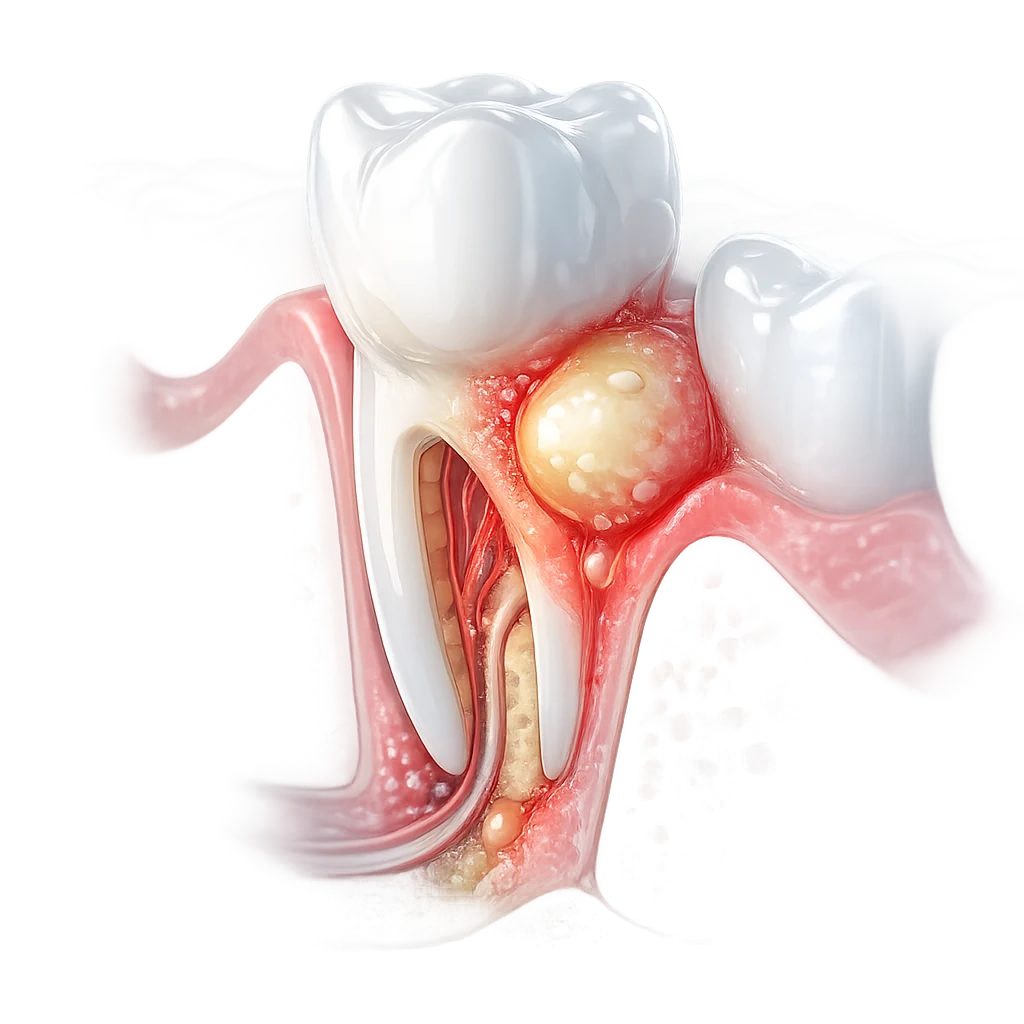


It is important to note here that a swollen area of the mucosa is not necessarily an abscess. Depending on the composition of the exudate (fluid), there are two types: serous edema and abscess. Externally, both complications look similar, but in the case of an abscess, the exudate consists of pus (dead neutrophils), while in serous edema it consists of proteins dissolved in water (predominantly albumin).
It is believed that serous edema can be treated with anti-inflammatory medications. However, the chief surgeon of “Osadchyi Dental Clinic” – Ihor Oleksandrovych – says the following: “Even with serous edema, I make a relieving incision – I give the exudate an opportunity to drain and prevent its further transformation into pus.”
An abscess is a complication in 100% of cases, so its symptoms include five signs of inflammation:
- pain (especially pronounced upon palpation – pressing);
- redness (redness of the mucosa in the area of localization);
- swelling (caused by accumulation of pus);
- elevated body temperature;
- functional impairment.
Dental abscess: additional symptoms
- increased tooth sensitivity (reaction to cold or hot food);
- tooth mobility;
- pus discharge from tooth pockets;
- enlargement and tenderness of lymph nodes under the jaw or in the neck;
- general malaise (headache, fatigue, etc.);
- unpleasant taste and odor from the mouth.
The development of an abscess can be triggered by a number of causes:
Inflammatory causes:
- Gingivitis (inflammation of the oral mucosa tissues).
- Periodontitis (inflammation of the bone and mucosal tissues surrounding the tooth).
- Purulent periodontitis (inflammation and purulent processes in the alveolar ridge surrounding the tooth root).
- Osteomyelitis (bone inflammation).
Infectious causes:
- Bacterial infection that occurs when bacteria penetrate inside the tooth through carious cavities or damaged tissues.
- Viral infection (for example: herpes simplex virus).
Traumatic causes:
- A blow, injury, or tooth fracture that disrupts the integrity of the dental crown, root, or bone, creating conditions for infection development.
- Trauma caused by surgical procedures (abscess after tooth extraction).
Note that the risk of abscess development also increases with systemic diseases such as diabetes mellitus: the disease increases the risk of infection and slows healing processes due to vascular pathology. In addition, poor hygiene can be a factor contributing to abscess formation, as it promotes the accumulation of bacteria and the development of carious processes.

Extensive experience
Стаж работы челюстно-лицевой хирурга 38 лет, из них 8 лет — работа дежурным врачом отделения острой травмы.

Number of surgeries
Over 2,000 successful surgeries in the field of maxillofacial surgery.

Quality of work
Thanks to a thorough approach in diagnostics and treatment planning for each clinical case, we achieve a minimal number of complications.
Three methods are used to diagnose an abscess:
- clinical examination (examination of the oral cavity and palpation);
- X-ray (a dental abscess may require an image to assess the condition of bone tissue and root canals, as well as the severity of infection);
- CT scan (may be ordered to obtain a more detailed picture of tooth anatomy and surrounding tissues).
It should be noted that at the diagnostic stage, it is important to understand the cause – the underlying disease that led to abscess formation. The logic is as follows: the abscess is a consequence that must be eliminated, but it is also important to address the cause to prevent recurrence of abscesses and other pathological conditions.
Therefore, abscess treatment can be conditionally divided into two medical procedures: incision of the abscess (its elimination) and treatment of the underlying disease.
Abscess removal: stages
| Stage | Description |
| Anesthesia | Involves the use of anesthetics and an antiseptic solution for mouth rinsing |
| Incision | A surgical instrument is used to make an incision in the mucosa – creating a drainage opening |
| Abscess drainage | The surgeon carefully compresses the area around the abscess to facilitate the drainage of pus and remaining infected tissue through the drainage opening |
| Irrigation | The abscess area is rinsed with an antiseptic solution to clean and remove remaining infected tissues and pus |
| Drain insertion (if necessary) | In some cases, a drainage tube or strip may be temporarily placed in the drainage opening to facilitate continuous drainage |
| Post-operative recommendations | To fight the infection, the doctor may prescribe a course of antibiotics. Further treatment should also be planned |

If a dental abscess is not incised in time, the following complications may develop:
- fistula formation;
- tooth loss;
- cosmetic problems (facial abscess);
- jaw osteomyelitis (inflammatory process in bone tissue);
- sinusitis (paranasal sinus infection);
- phlegmon (diffuse purulent inflammation);
- sepsis (generalized blood infection).
Warning! Osteomyelitis, sinusitis, phlegmon, and sepsis – all of these conditions are potentially fatal. Untimely or improper treatment can lead to the patient’s death. Therefore, ignoring dental abscesses and provoking the development of complications is extremely dangerous; immediate medical attention should be sought.
The cost of abscess removal surgery depends on the degree of complexity, individual clinical presentation, and the size of the abscess. The price of abscess incision in Kyiv averages 3–5 thousand hryvnias.
No! Delaying a visit to the doctor means putting yourself in great danger. An unincised abscess will not only fail to “resolve” but will lead to the development of more serious, sometimes fatal, complications.
No! In medicine, there is a mandatory rule: “where there is pus – incise.” If we are talking about serous edema, it can be treated with medication. However, there remains a risk that serous edema will turn into an abscess. In any case, if you suspect a dental abscess, you should consult a doctor.
An abscess is a consequence of untreated diseases. Abscess formation can be prevented by: maintaining good hygiene, seeking timely medical attention if you suspect the development of dental and oral diseases, and visiting the dentist for scheduled check-ups every six months.