Didn’t find the necessary information? Make an appointment for a consultation with oral surgeon Ihor Oleksandrovych Osadchy.
Impacted Wisdom Tooth Removal
Not every person has a full set of wisdom teeth, but even a single third molar can sometimes cause significant problems. Impacted wisdom tooth removal is offered by many clinics in Ukraine and Kyiv. However, it is important to remember that such operations are considered the domain of maxillofacial surgeons rather than general dental surgeons, and not every clinic has them on staff.
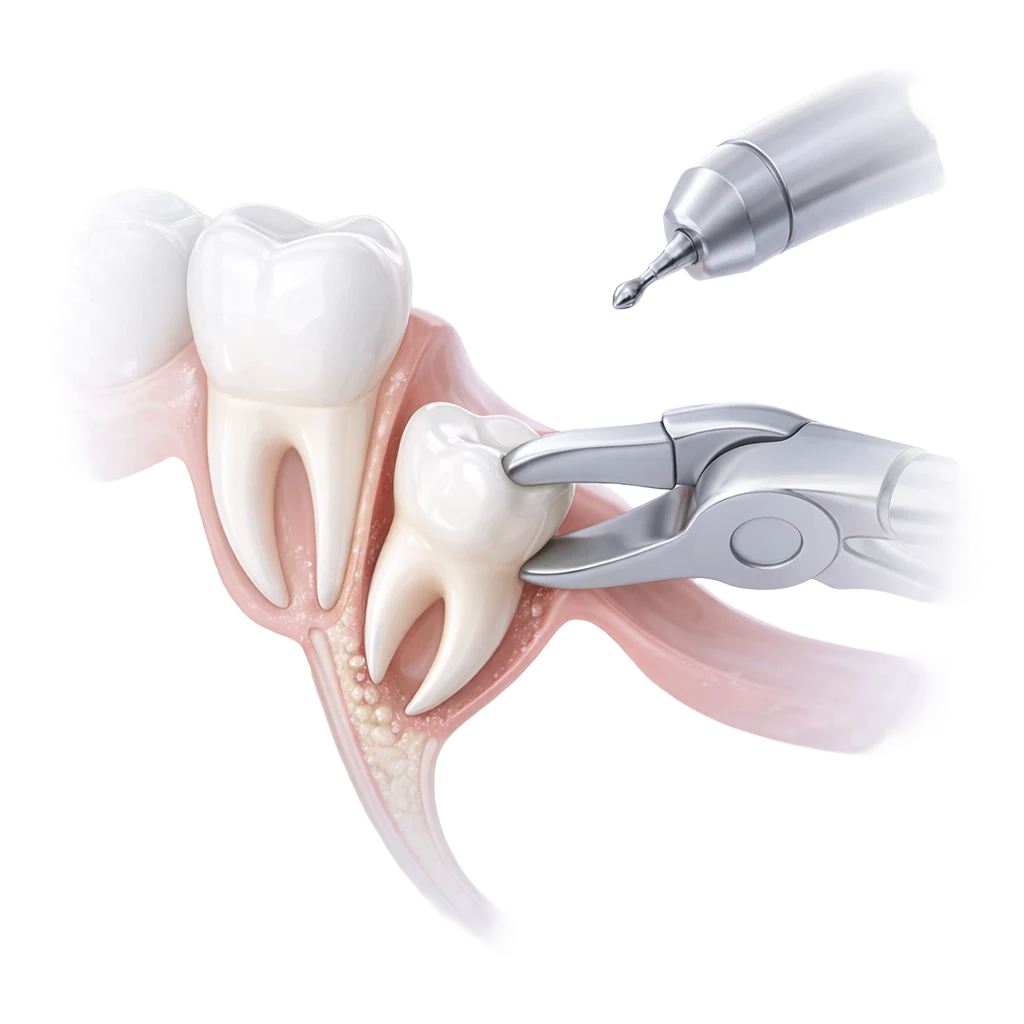


While our distant ancestors needed third molars for chewing raw or very hard food, modern humans find wisdom teeth bring more problems than benefits.
Through evolution, the human skull and jaw have changed, and quite often there is simply not enough room for wisdom teeth to erupt normally. To avoid future problems, many dentists recommend that their patients have unerupted wisdom teeth removed on a planned basis.
An impacted wisdom tooth is a tooth that cannot erupt normally. It is important to understand that a wisdom tooth that has not yet erupted should not automatically be considered impacted, since in this case we are talking about a tooth that physically cannot erupt even given sufficient time.
Causes of impacted wisdom teeth:
- lack of space (there is insufficient room in the jawbone for normal eruption);
- bone obstructions (dense bone or other structural features of the jaw).
Wisdom teeth can be not only impacted but also dystopic — that is, positioned incorrectly (tilted, protruding, or rotated along their axis).
Situations in which a wisdom tooth is both impacted and dystopic are possible and frequently encountered in practice. This means that even before eruption, it is clear that the tooth is already in an incorrect position. This can be determined based on an X-ray.

Extensive experience
Стаж работы челюстно-лицевой хирурга 38 лет, из них 8 лет — работа дежурным врачом отделения острой травмы.

Number of surgeries
Over 2,000 successful surgeries in the field of maxillofacial surgery.

Quality of work
Thanks to a thorough approach in diagnostics and treatment planning for each clinical case, we achieve a minimal number of complications.
The presence of an impacted and especially an impacted and dystopic wisdom tooth is a direct indication for its removal. Patients often hesitate to undergo surgery, justifying their reluctance by saying the tooth does not bother them, but this is only a matter of time.
An impacted wisdom tooth should be removed to avoid:
- pain. Sooner or later the tooth will begin to press on tissues, causing first discomfort and then pain. Sometimes unerupted wisdom teeth also cause headaches;
- infection. Impacted wisdom teeth create problems for cleaning and hygiene, increasing the risk of infections and oral diseases;
- damage to adjacent teeth. The tooth can put pressure not only on soft tissues but also on neighboring healthy teeth, thereby destroying them;
- tumor development;
- malocclusion formation.
1. Diagnosis
Quite often, patients begin to suspect that an impacted wisdom tooth requires removal based on the following symptoms:
- discomfort and pain;
- mucosal swelling;
- pain when chewing;
- pain and difficulty when opening the mouth.
Ideally, it is better not to wait for such symptoms to appear, and for this one should not neglect routine check-ups with a doctor. The doctor can take an X-ray and immediately determine whether the tooth needs to be removed or if there is a chance for its physiological eruption. Let us emphasize: removal of impacted wisdom teeth, even with symptoms present, is impossible without a preliminary X-ray — before the operation, the surgeon must see the full picture.
2. Impacted Wisdom Tooth Removal Surgery
Wisdom tooth removal can be performed under local anesthesia or under general anesthesia.
During the operation, the surgeon must first gain access to the tooth: the mucosa is incised, and in some cases, part of the bone tissue may also be removed. The doctor then removes the tooth and places sutures.
3. Rehabilitation
After impacted wisdom tooth removal, a period of rehabilitation and recovery begins. The patient is prescribed painkillers and anti-inflammatory medications. It is also recommended to refrain from smoking, alcohol consumption, and to limit physical activity for the first few days after surgery. It goes without saying that the patient must also follow hygiene guidelines.
4. Suture Removal and Examination
Depending on the patient’s individual characteristics, sutures are removed 7-14 days after surgery.
The operation may be complicated by a number of factors, requiring greater experience from the doctor and the use of more instruments.
Factors affecting the complexity of the operation:
| Factor | Description |
|---|---|
| Deep positioning | The tooth is located deep in the bone tissue |
| Dystopic tooth | The tooth is tilted at an angle or rotated along its axis |
| Proximity to nerves | The tooth is located close to nerves, blood vessels, or other structures in the jaw |
| Need for sectioning | The tooth must be cut into several parts before extraction from the bone |
There are also specific considerations when removing impacted wisdom teeth depending on whether they are in the upper or lower jaw.

Removal of upper impacted wisdom teeth is complicated by the fact that these teeth are anatomically adjacent to the maxillary sinuses. Therefore, there is a risk of perforation and penetration into the sinus, which can lead to odontogenic sinusitis. To avoid such complications, dental surgeons often use so-called cautious approaches when removing impacted upper jaw teeth.
Removal of lower impacted wisdom teeth may be complicated by their close proximity to the inferior alveolar nerve. Trauma to this nerve is highly undesirable and can lead to numbness of the lip, tongue, and chin. Despite the fact that the numbness eventually passes, the surgeons at our clinic avoid causing additional trauma when removing impacted lower jaw teeth.
Yes. Indeed, wisdom teeth may have not just 2-3 roots, but even 5. And of course, this circumstance affects the complexity of the operation and the time it takes.
No, such a restriction does not exist. After wisdom tooth removal, it is advisable to refrain from visiting a bathhouse or sauna and from taking very hot baths for three days. Smoking and alcohol consumption are also not recommended, but you can wash your hair and take a shower.
Wisdom tooth removal, especially of impacted teeth, involves inflicting controlled trauma. There is an excess of blood in the traumatized area, which leads to swelling. Typically, swelling after removal lasts up to three days. However, some patients experience no swelling or only minor swelling after surgery.
Mild aching pain after extraction may persist for 3-4 days. Over the following two weeks, minor pain may occasionally occur.
Some dental clinics in Kyiv offer impacted wisdom tooth removal under general anesthesia, positioning it as some kind of new service. In reality, performing dental operations under general anesthesia is nothing new. At our clinic, we also perform dental operations under general anesthesia, but only when there are direct medical indications.
It should be noted that in Europe, impacted wisdom tooth removal operations are performed under general anesthesia and are considered comparable in complexity to appendectomy procedures. European medical professionals also take into account the severity of psychological trauma inflicted on the patient. Impacted wisdom tooth removal under general anesthesia has its merits, as the operation is not only complex but also lengthy (at least 30 minutes).
However, wisdom tooth removal under general anesthesia in Kyiv has become more of a marketing gimmick than a medical necessity.
Among the significant disadvantages of using general anesthesia, two should be noted:
- it is more difficult for the surgeon to work with a completely unresponsive patient;
- the cost of the operation increases significantly.
The cost of impacted wisdom tooth removal under general anesthesia increases substantially. The patient should understand that they will additionally need:
- a package of tests;
- an anesthesiologist consultation;
- anesthesiological support.
At our clinic, we recommend using general anesthesia when it comes to complex and expectedly lengthy operations, and we also advise taking the opportunity to remove all wisdom teeth at once.
The cost of impacted wisdom tooth removal under local anesthesia will be at least three times lower than the cost of a similar operation under general anesthesia. At the same time, the use of good patented anesthesia guarantees patient comfort and the absence of pain. In Kyiv, the average cost of impacted wisdom tooth removal ranges from 5 to 8 thousand hryvnias.
In conclusion, here are the words of our clinic’s chief surgeon, Ihor Osadchyi: «Experience, skill, and speed — these are the keys to success. The faster the operation, the easier it is for the patient. We first remove two wisdom teeth and then ask: is the patient ready to continue, or should the removal of the remaining teeth be rescheduled for another time. As a rule, we manage to quickly remove all four wisdom teeth at once and relieve the patient of suffering».


 Reviews

Ой ,як добре ! Зуби як в молодого! Щиро дякую та бажаю більше вдячних клієнтів. Імплантами задоволений на 100%, а лікуванням зубів ще більше.
Дай бог Вам процвітання а Ігорю Олександровичу довгії літа і мою повагу.
Володимир.
Read more

Добрий день. Хочу поділитися своїми враженнями про стоматологію. Пролікувалися всією родиною, залишилися дуже задоволені! Хороше сучасне обладнання та технології. Лікарі дуже ввічливі, знають свою роботу на всі 100 процентів. Дуже уважний, професійний лікар Шляховий Олексій Анатолійович, завдяки йому не так страшно йти до стоматолога))). Дякуємо за якісне та безболісне лікування! Рекомендую всім!
Read more

Дуже комфортна та професійна клініка! Вперше звернувсч до пані Костенко Наталії Миколаївні 12 років тому, і протягом усього часу жодного разу не пошкодував. Задоволений професіоналізмом лікаря, якістю послуги та вмінням знайти індивідуальний підхід до кожного клієнта. Послугами клініки користується вся наша родина. Тому із задоволенням рекомендую! А лікарям клініки бажаю успіхів, розвитку та усміхнених клієнтів!
Read more

Дякую за Вашу роботу! Гарна і охайна клініка, ввічливий персонал. Звернулась до лікаря Катерини Олександрівної для встановлення імпланта. Перед цим мені запропонували зробити чистку і вилікувати карієс. Роботою дуже задоволена, буду звертатись у майбутньому і рекомендувати друзям і знайомим!
Read more

Щойно повернулася з прийому в стоматології – і я під враженням! 🙌
Все пройшло супер комфортно: привітні адміністратори, сучасне обладнання та головне — уважний лікар, який пояснив і зробив акуратно і без болю.
Пішла з усмішкою, і тепер точно знаю, куди повернуся наступного разу. Дякую вам за турботу та атмосферу! 💙🦷
Read more

Відвідуємо стоматологію всією родиною.
Ключовий фактор це компетентність спеціалістів.Шляховий Анатолій Олексійович допоміг вирішити проблему, яка дошкуляла не один рік. Щиро дякуємо!
Катерині Олександрівній, своїм підходом до роботи з пацієнтом позбавила страху стоматологів))
Професіоналізм та сервіс заслуговують найвищої оцінки❤️
Read more

Я залишилась дуже задоволена! Атмосфера приємна, все чисто й затишно. Процедура пройшла швидко та максимально комфортно. Особливо дякую Осадчому Ігорю, все робить акуратно й професійно, а ще підтримує теплу розмову — час пролітає непомітно 😊
Read more

Завжди лікусь лише у Самокіної Катерини Олександрівни, дуже рекомендую, чудовий лікар + зручна локація клініки, все подобається.
Read more

Дуже хороша клініка, зокрема лікар Наталія Миколаївна 🤍 проходила у неї лікування брекетами, і досі настільки задоволена результатом, що і тепер чоловік теж проходить тут лікування. Завжди приємне ставлення 🫶🏼
Read more

Дякую Катерині Олександрівні за чудову роботу! Справжній професіонал з “золотими руками”. Навіть найскладніші процедури проходили абсолютно безболісно – у неї дуже легка рука.
Read more

Про лікаря Ігоря Олександровича дізналися завдяки YouTube, і це було найкраще рішення звернутися саме до нього. Він проводить установку імплантів без синус-ліфтингу – складну роботу, за яку більшість лікарів не беруться.
Щиро вдячні за його професіоналізм, уважність і людяність. Весь процес проходив комфортно та безболісно. Атмосфера в клініці дуже приємна, персонал доброзичливий, відчувається турбота й щире бажання допомогти.
Завдяки досвіду та сучасному підходу лікаря отримали чудовий результат без зайвих процедур.
Відтепер із упевненістю довіряємо здоров’я зубів саме Ігорю Олександровичу!
Окрема подяка ❤️ керівнику клініки Діані! За оперативне реагування на нашу проблему та бажання допомогти!
Ви команда професіоналів!
Read more

Рекомендую 100%
Скористалась лише однією послугою – панорамний знімок щелепи, але вже можу оцінити ставлення до клієнта та сервіс в загальному. Люди працюють на високому рівні це точно.
Read more

Клініка дуже гарна. Дизайн розслабляє та знімає напругу перед та після відвідування лікаря. Персонал клініки попереджувальний та уважний, з перших хвилин відчуваєш, що ти їм дорогий, вони раді тебе обслужити. Про лікарів можу сказати, що перший раз у свої 67 років, на прийомі навіть трохи подрімала. Це ж нонсен … але це так. Рекомендую
Read more

Вже не вперше звертаюся до цієї клініки – все завжди дуже швидко та якісно. Окрема подяка Осадчому Ігорю за професіоналізм і уважне ставлення: видалення зубів пройшло швидко, безболісно та комфортно!
Read more

Дуже рекомендую!
Робив повний цикл: лікування зубів, видалення мудрих, установка брекетсистеми, потім відбіл. Чудово!
Дружина видаляла відразу 4 зуби мудрості під наркозом – все було супер та швидке відновлення!
Доньці зубки теж лікували ⭐️👍
Read more

Нам дуже сподобалося. ПРИЙНЯЛИ дитину без запису попереднього адже болів зуб. Дякую🫶🏻Сервіс на вищому рівні, працюють професіонали своєї справи.
Read more