Didn’t find the necessary information? Make an appointment for a consultation with oral surgeon Ihor Oleksandrovych Osadchy.
Clasp Denture
Clasp denture technology, still very popular in Ukraine and Kyiv, has a number of significant disadvantages. We recommend that our patients carefully review the various types of clasp dentures, their limitations, and drawbacks. Only after a thorough analysis should a decision be made regarding the use of clasp dentures.
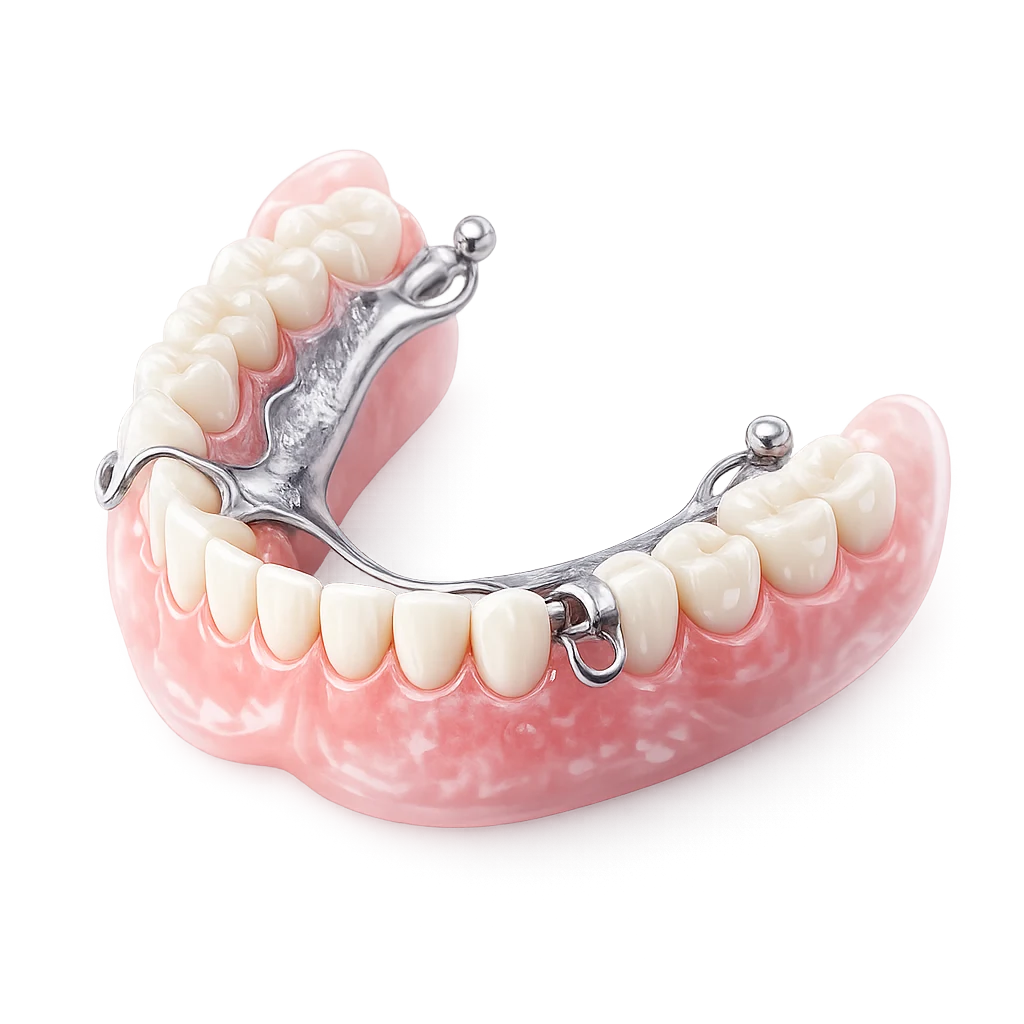

A clasp denture is a type of removable dental prosthesis based on a metal arc (clasp) that connects the left and right parts of the denture. The name comes from the German word “Bügel,” meaning “bracket” or “curved metal element.”
Clasp dentures cannot be called a new technology. They began to be used in dentistry at the beginning of the 20th century. At that time, specialists faced the challenge of creating more reliable removable dental prostheses that would be better fixed in the patient’s mouth. Clamp and bridge prostheses, which were widely used at the time, either had poor fixation or significant aesthetic drawbacks.

The idea of using clasps was a breakthrough in dentistry of the last century. The essence of the technology was to create a metal base that would ensure firm fixation of the prosthesis in the patient’s mouth. Gradually, the technology evolved from metal blanks to complex clasp systems.
The advent of clasp dentures was a breakthrough in 20th-century dentistry and provided a new level of comfort for patients who had lost some of their own teeth. However, today technologies have advanced far ahead, and clasp dental prostheses are used less and less in the modern world, as they have a number of significant disadvantages.

Extensive experience
Стаж работы челюстно-лицевой хирурга 38 лет, из них 8 лет — работа дежурным врачом отделения острой травмы.

Number of surgeries
Over 2,000 successful surgeries in the field of maxillofacial surgery.

Quality of work
Thanks to a thorough approach in diagnostics and treatment planning for each clinical case, we achieve a minimal number of complications.
Clasp dentures cannot be placed on a completely edentulous jaw, as proper fixation is achieved through the patient’s remaining natural teeth — there must be at least 6. Depending on the method of attaching the prosthesis to the patient’s own teeth, the material, and design variations, the following types of clasp dental prostheses can be distinguished:
| Description | Attachment Type | Features |
|
A removable prosthesis on a metal base. Can be made of chromium nickelide, cobalt-chromium alloy, gold, or even platinum. Sometimes combined materials are used for the base: metal + plastic, metal + thermoplastics |
Fixed to the patient’s own teeth using hooks or clasps |
|
An obvious disadvantage of classic clasp dentures is the heavy weight of the construction. Vladimir Markelov attempted to address this by inventing a new type of such prosthetics in the 1970s.
| Description | Attachment Type | Features |
| A thinner removable prosthesis made of metal alloys | Hooks and clasps are also used, attaching the prosthesis to the patient’s own teeth |
|
Another variety of clasp dentures was developed by dentists in the 1920s–1930s. Its main feature is that the prosthesis is attached to the patient’s own teeth using telescopic connections. For this purpose, telescopic crowns are placed on the patient’s own teeth. Such a prosthesis consists of two parts: removable and non-removable.
| Description | Attachment Type | Features |
| The prosthesis consists of two parts. The inner part — the support prosthesis — is placed on the patient’s own teeth. The outer part — the prosthesis itself — is secured to the inner part | Telescopic connection |
|
During the first few days, while the patient is getting used to the prosthesis, it is recommended not to remove it even at night. At the same time, it is important to remember that the prosthesis needs to be removed and thoroughly cleaned after each meal. Later on, the prosthesis should be removed at night to allow the mucosa to recover.
Clasp dentures can be used by patients for 5–7 years. With thorough hygiene, the lifespan of the prosthesis can be extended to 10 years. However, such prolonged wearing will lead to bone dystrophy, making further implantation impossible.
With clasp prosthetics, we are talking not about replacing the prosthesis, but about rebasing it. Over time, the jawbones under the prostheses become thinner, and the prosthesis does not fit tightly against the mucosa. Therefore, it is necessary to rebase the prosthesis every six months to a year.
Clasp dental prosthetics are impossible if the patient has no natural teeth. This type of removable prosthetics involves fixing the construction to the patient’s remaining natural teeth.
Depending on how exactly the clasp denture is fixed in the mouth, the following types of prostheses can be distinguished:
- Clasp denture on clammers (hooks, clasps)
The attachment is a hook that grips two-thirds of the patient’s teeth. With this type of fixation, the prosthesis will be noticeable in the mouth.
- Clasp denture on locks (clasp denture with lock fixation)
The first part of the attachment is placed on the patient’s own tooth, while the second is installed on the prosthesis — these can be either attachments or magnets. The snapping system most closely resembles the principle of clothing snap buttons.
- Clasp denture on telescopic connections
Using this type of attachment requires grinding down the patient’s own tooth and installing a special crown resembling a cap. The second part of the attachment is inside the prosthesis, which literally fits over the crowns. The operating principle resembles an extending telescope.

Prosthetics stages:
- preparation of teeth for crowns;
- creation of impressions of both jaws;
- preparation of temporary structures;
- prosthesis fitting;
- installation of the permanent structure and fixation.
The different structure of the upper and lower jaws, as well as their different masticatory (chewing) functions, determine differences in the modelling and attachment of prostheses.
Clasp dentures for the upper jaw may have cutouts that account for the anatomical structure of the palate. The thickness of the bridge in such prostheses reaches 1.2 mm, and the width can vary: from 4 to 10 mm. The prosthesis itself is fixed to the lateral incisors.
When modelling a prosthesis for the lower jaw, the anatomical structure of the tongue is taken into account. The prosthesis arc must be spaced from the mucosa at varying distances: 0.5 mm at the upper edge and 1 mm at the lower edge. The structure is attached to the lateral incisors.
- Ischaemia and Bone Dystrophy
A clasp dental prosthesis exerts considerable pressure on the mucosal tissues, thereby provoking ischaemia — insufficient blood supply to the tissues. As a result of prolonged wearing of this type of prosthesis, the bones of the upper and lower jaws become thinner, making further prosthetics on implants impossible.
- Limited Stability
A removable clasp denture, due to the anatomical features or a small number of the patient’s own teeth, may not be stable enough in the mouth. In addition, constant changes in the mucosa caused by ischaemia lead to a loss of tight fit of the prosthesis. Therefore, clasp dentures require constant rebasing.

- Low Aesthetic Performance
Depending on the type of attachment, clasp dentures may be visible in the patient’s mouth not only when smiling, but even during conversation.
- Discomfort and Speech Problems
A heavy, tightly fitting prosthesis causes discomfort for the patient and sometimes provokes speech defects. The patient requires a long adaptation period.
Regardless of the type and attachment method, a clasp denture, due to the listed disadvantages, is used less and less in dental practice. At our clinic, we use it only as a temporary measure.
Not only the disadvantages of the technology limit the use of clasp dentures — there are also direct medical contraindications:
- absence or insufficient number of the patient’s own teeth;
- mobility of own teeth;
- healing period of the mucosa after surgical intervention;
- diseases of teeth and mucosa that may be aggravated by wearing a clasp denture;
- pronounced atrophy of the alveolar ridge (jawbone).
The cost of a clasp denture can vary depending on the type of fixing element: the better and more complex the clasp design, the higher the price. The cost of a clasp dental prosthesis also increases if special crowns are needed to fix it.
Manufacturing a clasp denture requires the involvement of dental laboratory specialists, and the lion’s share of the final cost is the cast construction of the prosthesis base.
Thus, the price of clasp dentures will initially be higher than that of similar nylon or acrylic ones. Additionally, constant wearing of the prosthesis will require periodic rebasing, which will also affect the overall cost of clasp prosthetics.
Despite the fact that many clinics in Kyiv continue to use clasp dentures, our specialists do not recommend them from either a medical or economic standpoint.
The high final cost of such prosthetics, combined with significant medical and aesthetic disadvantages, makes the technology unacceptable. Created at the beginning of the 20th century, it was indeed a breakthrough in dentistry, but today prosthetics on implants exist. They allow creating non-removable prostheses that feel and look like the patient’s own teeth. If the patient has contraindications to implantation, we recommend using either acrylic or nylon prostheses — in terms of aesthetics and functionality, they are not inferior to clasp ones, and their cost is significantly lower.

 Reviews

Ой ,як добре ! Зуби як в молодого! Щиро дякую та бажаю більше вдячних клієнтів. Імплантами задоволений на 100%, а лікуванням зубів ще більше.
Дай бог Вам процвітання а Ігорю Олександровичу довгії літа і мою повагу.
Володимир.
Read more

Добрий день. Хочу поділитися своїми враженнями про стоматологію. Пролікувалися всією родиною, залишилися дуже задоволені! Хороше сучасне обладнання та технології. Лікарі дуже ввічливі, знають свою роботу на всі 100 процентів. Дуже уважний, професійний лікар Шляховий Олексій Анатолійович, завдяки йому не так страшно йти до стоматолога))). Дякуємо за якісне та безболісне лікування! Рекомендую всім!
Read more

Дуже комфортна та професійна клініка! Вперше звернувсч до пані Костенко Наталії Миколаївні 12 років тому, і протягом усього часу жодного разу не пошкодував. Задоволений професіоналізмом лікаря, якістю послуги та вмінням знайти індивідуальний підхід до кожного клієнта. Послугами клініки користується вся наша родина. Тому із задоволенням рекомендую! А лікарям клініки бажаю успіхів, розвитку та усміхнених клієнтів!
Read more

Дякую за Вашу роботу! Гарна і охайна клініка, ввічливий персонал. Звернулась до лікаря Катерини Олександрівної для встановлення імпланта. Перед цим мені запропонували зробити чистку і вилікувати карієс. Роботою дуже задоволена, буду звертатись у майбутньому і рекомендувати друзям і знайомим!
Read more

Щойно повернулася з прийому в стоматології – і я під враженням! 🙌
Все пройшло супер комфортно: привітні адміністратори, сучасне обладнання та головне — уважний лікар, який пояснив і зробив акуратно і без болю.
Пішла з усмішкою, і тепер точно знаю, куди повернуся наступного разу. Дякую вам за турботу та атмосферу! 💙🦷
Read more

Відвідуємо стоматологію всією родиною.
Ключовий фактор це компетентність спеціалістів.Шляховий Анатолій Олексійович допоміг вирішити проблему, яка дошкуляла не один рік. Щиро дякуємо!
Катерині Олександрівній, своїм підходом до роботи з пацієнтом позбавила страху стоматологів))
Професіоналізм та сервіс заслуговують найвищої оцінки❤️
Read more

Я залишилась дуже задоволена! Атмосфера приємна, все чисто й затишно. Процедура пройшла швидко та максимально комфортно. Особливо дякую Осадчому Ігорю, все робить акуратно й професійно, а ще підтримує теплу розмову — час пролітає непомітно 😊
Read more

Завжди лікусь лише у Самокіної Катерини Олександрівни, дуже рекомендую, чудовий лікар + зручна локація клініки, все подобається.
Read more

Дуже хороша клініка, зокрема лікар Наталія Миколаївна 🤍 проходила у неї лікування брекетами, і досі настільки задоволена результатом, що і тепер чоловік теж проходить тут лікування. Завжди приємне ставлення 🫶🏼
Read more

Дякую Катерині Олександрівні за чудову роботу! Справжній професіонал з “золотими руками”. Навіть найскладніші процедури проходили абсолютно безболісно – у неї дуже легка рука.
Read more

Про лікаря Ігоря Олександровича дізналися завдяки YouTube, і це було найкраще рішення звернутися саме до нього. Він проводить установку імплантів без синус-ліфтингу – складну роботу, за яку більшість лікарів не беруться.
Щиро вдячні за його професіоналізм, уважність і людяність. Весь процес проходив комфортно та безболісно. Атмосфера в клініці дуже приємна, персонал доброзичливий, відчувається турбота й щире бажання допомогти.
Завдяки досвіду та сучасному підходу лікаря отримали чудовий результат без зайвих процедур.
Відтепер із упевненістю довіряємо здоров’я зубів саме Ігорю Олександровичу!
Окрема подяка ❤️ керівнику клініки Діані! За оперативне реагування на нашу проблему та бажання допомогти!
Ви команда професіоналів!
Read more

Рекомендую 100%
Скористалась лише однією послугою – панорамний знімок щелепи, але вже можу оцінити ставлення до клієнта та сервіс в загальному. Люди працюють на високому рівні це точно.
Read more

Клініка дуже гарна. Дизайн розслабляє та знімає напругу перед та після відвідування лікаря. Персонал клініки попереджувальний та уважний, з перших хвилин відчуваєш, що ти їм дорогий, вони раді тебе обслужити. Про лікарів можу сказати, що перший раз у свої 67 років, на прийомі навіть трохи подрімала. Це ж нонсен … але це так. Рекомендую
Read more

Вже не вперше звертаюся до цієї клініки – все завжди дуже швидко та якісно. Окрема подяка Осадчому Ігорю за професіоналізм і уважне ставлення: видалення зубів пройшло швидко, безболісно та комфортно!
Read more

Дуже рекомендую!
Робив повний цикл: лікування зубів, видалення мудрих, установка брекетсистеми, потім відбіл. Чудово!
Дружина видаляла відразу 4 зуби мудрості під наркозом – все було супер та швидке відновлення!
Доньці зубки теж лікували ⭐️👍
Read more

Нам дуже сподобалося. ПРИЙНЯЛИ дитину без запису попереднього адже болів зуб. Дякую🫶🏻Сервіс на вищому рівні, працюють професіонали своєї справи.
Read more