Didn’t find the necessary information? Make an appointment for a consultation with oral surgeon Ihor Oleksandrovych Osadchy.
Maxillary Sinusotomy
Sinusitis, chronic sinusitis is a common problem that drives people to visit an ENT specialist. But not always should sinusitis sufferers go to an otolaryngologist — quite often the right decision is to visit a maxillofacial surgeon. Why is that? What is maxillary sinusotomy? What are the results and cost of maxillary sinusotomy? — we explain in detail below.

Sinusitis is an inflammation of the mucous membrane of the maxillary paranasal sinuses (maxillary sinus). The maxillary cavity (sinus) is lined with a mucous membrane, and its infection causes sinusitis. Thus, the nature of the disease is the same — an inflammatory process. However, there can be two sources of infection.

Not many people know that the source of maxillary sinus infection can also be the teeth. In this case, it is odontogenic (dental) sinusitis, and a maxillofacial surgeon should be consulted for treatment.
Odontogenic sinusitis can be caused by problems with upper lateral teeth — premolars and molars (5th, 6th, 7th, 8th, sometimes 4th tooth).
Dental sinusitis can result from:
- poor-quality endodontic treatment: if the canal was not fully accessed, not completely treated, or infection remained — a cystogranuloma may develop at the root apex
- poor-quality canal filling: filling material extends beyond the root apex and enters the maxillary sinus
- poor-quality tooth extraction: a piece of root may fall into the maxillary sinus
- atypical positioning of wisdom teeth: if wisdom teeth with their follicles are located in the maxillary sinuses, or if the roots of wisdom teeth are highly intertwined
- complications after bone grafting procedures, such as sinus lift
- foreign body entry: most commonly this refers to implants that fall into the maxillary sinus (sometimes in such cases dentists refer to ENT, but it is impossible to retrieve an implant from the maxillary sinus with an endoscope)

Extensive experience
Стаж работы челюстно-лицевой хирурга 38 лет, из них 8 лет — работа дежурным врачом отделения острой травмы.

Number of surgeries
Over 2,000 successful surgeries in the field of maxillofacial surgery.

Quality of work
Thanks to a thorough approach in diagnostics and treatment planning for each clinical case, we achieve a minimal number of complications.
Surgical treatment of sinusitis can be performed through the external nasal passage or through the oral cavity. In cases of dental sinusitis treatment at our clinic, maxillary sinusotomy is performed by a maxillofacial surgeon specifically through the oral cavity.

In a number of state clinics in Ukraine, including in Kyiv, maxillary sinusotomy is performed using outdated methods: access is made through a large window in the outer wall of the maxillary sinus through the mouth, and an anastomosis is created through the inferior nasal passage. Such surgical treatment of sinusitis requires general anesthesia, hospital stay, and subsequent removal of the tampon through the nose the next day after the surgery. Moreover, this process is very painful and poorly tolerated by patients.
At Osadchyi Dental Clinic, we believe that surgical treatment of sinusitis should be effective and less traumatic for the patient, which is why we use a proprietary technique based on evidence-based medicine and the experience of our maxillofacial surgeon (over 1,000 similar operations).
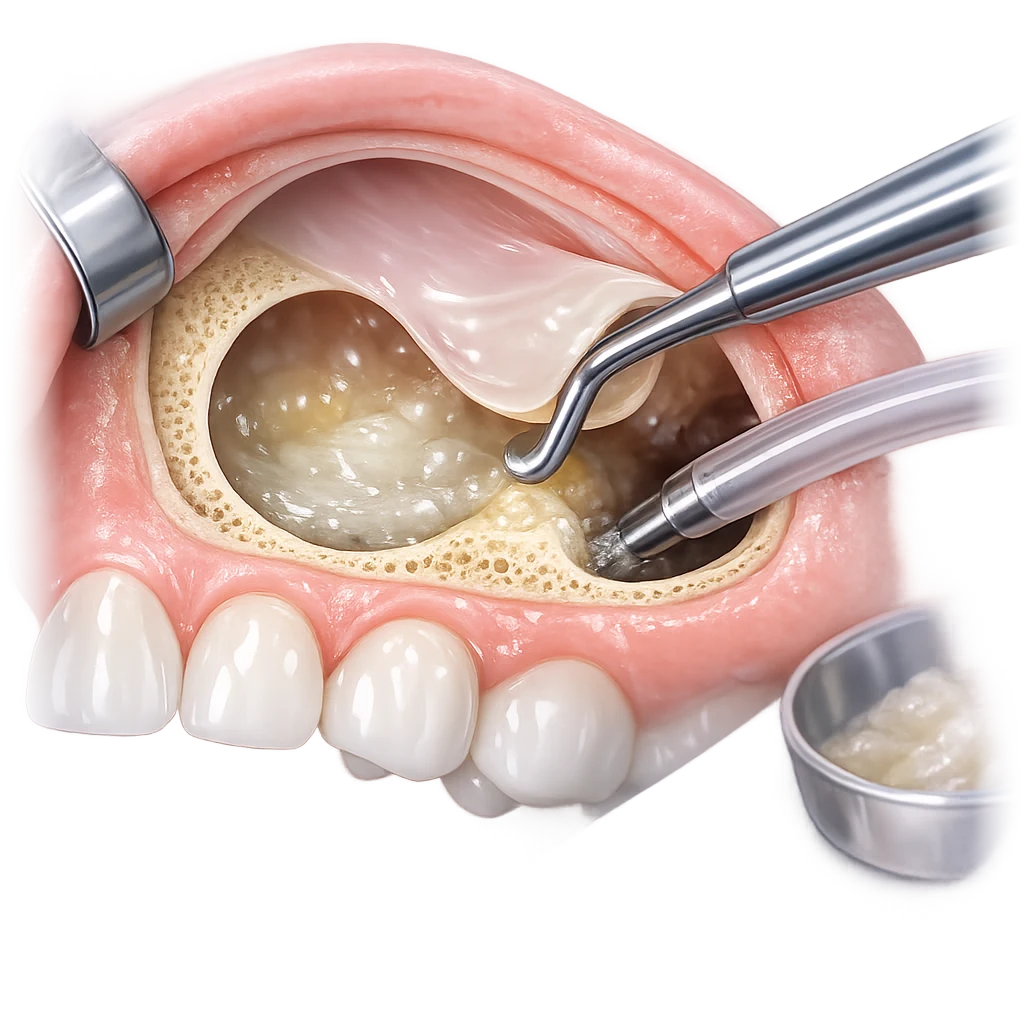
Treatment of sinusitis involves a set of procedures, the most important part of which is the sinusotomy operation itself. Above the tooth root, inside the mouth, an incision is made (1-1.5 cm), then a perforation into the maxillary sinus is performed, through which the infecting component, destroyed tissues, or neoplasms are removed, and the maxillary sinus is sanitized and treated with medication. Then the incision is sutured.
This sinusotomy is performed under local anesthesia and takes 30 to 60 minutes. If necessary, we perform histological examination of removed pathological tissues.
It is important to understand that sinusotomy involves removing all foreign matter from the maxillary sinuses. In some cases, sinusotomy with preservation of the causative tooth is possible. At the same time, sinusotomy with tooth extraction is sometimes necessary. After such surgery, we provide further dental rehabilitation, including implant placement.
In most cases, dental sinusitis is unilateral, but inflammation on both sides is possible — in such cases, bilateral sinusotomy is performed.
The following stages of treatment:
- Identification of the flora that caused the infection
(the flora can be fungal or anaerobic and provoke the development of mycetomas, polyps, cysts).
- Prescription of medications
(all medications are prescribed individually, depending on the clinical picture; these may be antibiotics and/or antibacterial drugs).
The cost of maxillary sinusotomy in Kyiv may vary depending on the clinic and the technologies used by the doctor. Minimally invasive sinusotomy using a proprietary technique at Osadchyi Dental Clinic does not exceed average market prices, while offering a number of important advantages not only in terms of the operation itself but also in terms of recovery.
Sinusotomy using our method leaves no traces: the entrance to the maxillary sinus is so small that it is impossible to notice. Externally, the patient looks completely normal after the surgery; slight swelling is possible only in patients with prominent subcutaneous fat tissue. The full recovery period is up to 5 days, with relief coming as early as the next day after the surgery.
At Osadchyi Dental Clinic, we take on the follow-up care and observation of the patient until recovery, which does not increase the cost of the sinusotomy.
The operation is safe and effective, which is why we recommend it to our patients. Unlike constant visits to the ENT, minimally invasive sinusotomy performed by an experienced maxillofacial surgeon can completely eliminate sinusitis.
The main symptoms of sinusitis are: difficulty breathing, discharge from one (less often both) side(s) of the nose, headache, heaviness, pain when bending over, sleep disturbance, periodic runny nose.

If you have chronic sinusitis and otolaryngologist treatment is not helping, it is most likely dental sinusitis. However, not every dentist can make the correct diagnosis. Therefore, you should consult a maxillofacial surgeon.

Recurrences with minimally invasive sinusotomy for dental sinusitis are very rare. If symptoms return, it can be considered reinfection, which is possible when treating very advanced sinusitis. However, reinfection is also observed rarely.

 Reviews

Ой ,як добре ! Зуби як в молодого! Щиро дякую та бажаю більше вдячних клієнтів. Імплантами задоволений на 100%, а лікуванням зубів ще більше.
Дай бог Вам процвітання а Ігорю Олександровичу довгії літа і мою повагу.
Володимир.
Read more

Добрий день. Хочу поділитися своїми враженнями про стоматологію. Пролікувалися всією родиною, залишилися дуже задоволені! Хороше сучасне обладнання та технології. Лікарі дуже ввічливі, знають свою роботу на всі 100 процентів. Дуже уважний, професійний лікар Шляховий Олексій Анатолійович, завдяки йому не так страшно йти до стоматолога))). Дякуємо за якісне та безболісне лікування! Рекомендую всім!
Read more

Дуже комфортна та професійна клініка! Вперше звернувсч до пані Костенко Наталії Миколаївні 12 років тому, і протягом усього часу жодного разу не пошкодував. Задоволений професіоналізмом лікаря, якістю послуги та вмінням знайти індивідуальний підхід до кожного клієнта. Послугами клініки користується вся наша родина. Тому із задоволенням рекомендую! А лікарям клініки бажаю успіхів, розвитку та усміхнених клієнтів!
Read more

Дякую за Вашу роботу! Гарна і охайна клініка, ввічливий персонал. Звернулась до лікаря Катерини Олександрівної для встановлення імпланта. Перед цим мені запропонували зробити чистку і вилікувати карієс. Роботою дуже задоволена, буду звертатись у майбутньому і рекомендувати друзям і знайомим!
Read more

Щойно повернулася з прийому в стоматології – і я під враженням! 🙌
Все пройшло супер комфортно: привітні адміністратори, сучасне обладнання та головне — уважний лікар, який пояснив і зробив акуратно і без болю.
Пішла з усмішкою, і тепер точно знаю, куди повернуся наступного разу. Дякую вам за турботу та атмосферу! 💙🦷
Read more

Відвідуємо стоматологію всією родиною.
Ключовий фактор це компетентність спеціалістів.Шляховий Анатолій Олексійович допоміг вирішити проблему, яка дошкуляла не один рік. Щиро дякуємо!
Катерині Олександрівній, своїм підходом до роботи з пацієнтом позбавила страху стоматологів))
Професіоналізм та сервіс заслуговують найвищої оцінки❤️
Read more

Я залишилась дуже задоволена! Атмосфера приємна, все чисто й затишно. Процедура пройшла швидко та максимально комфортно. Особливо дякую Осадчому Ігорю, все робить акуратно й професійно, а ще підтримує теплу розмову — час пролітає непомітно 😊
Read more

Завжди лікусь лише у Самокіної Катерини Олександрівни, дуже рекомендую, чудовий лікар + зручна локація клініки, все подобається.
Read more

Дуже хороша клініка, зокрема лікар Наталія Миколаївна 🤍 проходила у неї лікування брекетами, і досі настільки задоволена результатом, що і тепер чоловік теж проходить тут лікування. Завжди приємне ставлення 🫶🏼
Read more

Дякую Катерині Олександрівні за чудову роботу! Справжній професіонал з “золотими руками”. Навіть найскладніші процедури проходили абсолютно безболісно – у неї дуже легка рука.
Read more

Про лікаря Ігоря Олександровича дізналися завдяки YouTube, і це було найкраще рішення звернутися саме до нього. Він проводить установку імплантів без синус-ліфтингу – складну роботу, за яку більшість лікарів не беруться.
Щиро вдячні за його професіоналізм, уважність і людяність. Весь процес проходив комфортно та безболісно. Атмосфера в клініці дуже приємна, персонал доброзичливий, відчувається турбота й щире бажання допомогти.
Завдяки досвіду та сучасному підходу лікаря отримали чудовий результат без зайвих процедур.
Відтепер із упевненістю довіряємо здоров’я зубів саме Ігорю Олександровичу!
Окрема подяка ❤️ керівнику клініки Діані! За оперативне реагування на нашу проблему та бажання допомогти!
Ви команда професіоналів!
Read more

Рекомендую 100%
Скористалась лише однією послугою – панорамний знімок щелепи, але вже можу оцінити ставлення до клієнта та сервіс в загальному. Люди працюють на високому рівні це точно.
Read more

Клініка дуже гарна. Дизайн розслабляє та знімає напругу перед та після відвідування лікаря. Персонал клініки попереджувальний та уважний, з перших хвилин відчуваєш, що ти їм дорогий, вони раді тебе обслужити. Про лікарів можу сказати, що перший раз у свої 67 років, на прийомі навіть трохи подрімала. Це ж нонсен … але це так. Рекомендую
Read more

Вже не вперше звертаюся до цієї клініки – все завжди дуже швидко та якісно. Окрема подяка Осадчому Ігорю за професіоналізм і уважне ставлення: видалення зубів пройшло швидко, безболісно та комфортно!
Read more

Дуже рекомендую!
Робив повний цикл: лікування зубів, видалення мудрих, установка брекетсистеми, потім відбіл. Чудово!
Дружина видаляла відразу 4 зуби мудрості під наркозом – все було супер та швидке відновлення!
Доньці зубки теж лікували ⭐️👍
Read more

Нам дуже сподобалося. ПРИЙНЯЛИ дитину без запису попереднього адже болів зуб. Дякую🫶🏻Сервіс на вищому рівні, працюють професіонали своєї справи.
Read more