Didn’t find the necessary information? Make an appointment for a consultation with oral surgeon Ihor Oleksandrovych Osadchy.
Braces
Although the first braces appeared at the beginning of the 20th century, they have only become truly popular in the last 15–20 years. Today, more and more clinics in Kyiv and Ukraine offer their patients the opportunity to straighten teeth and correct bite. How do braces work? Who needs them and why? And what types of braces exist and what is the cost of braces installation?
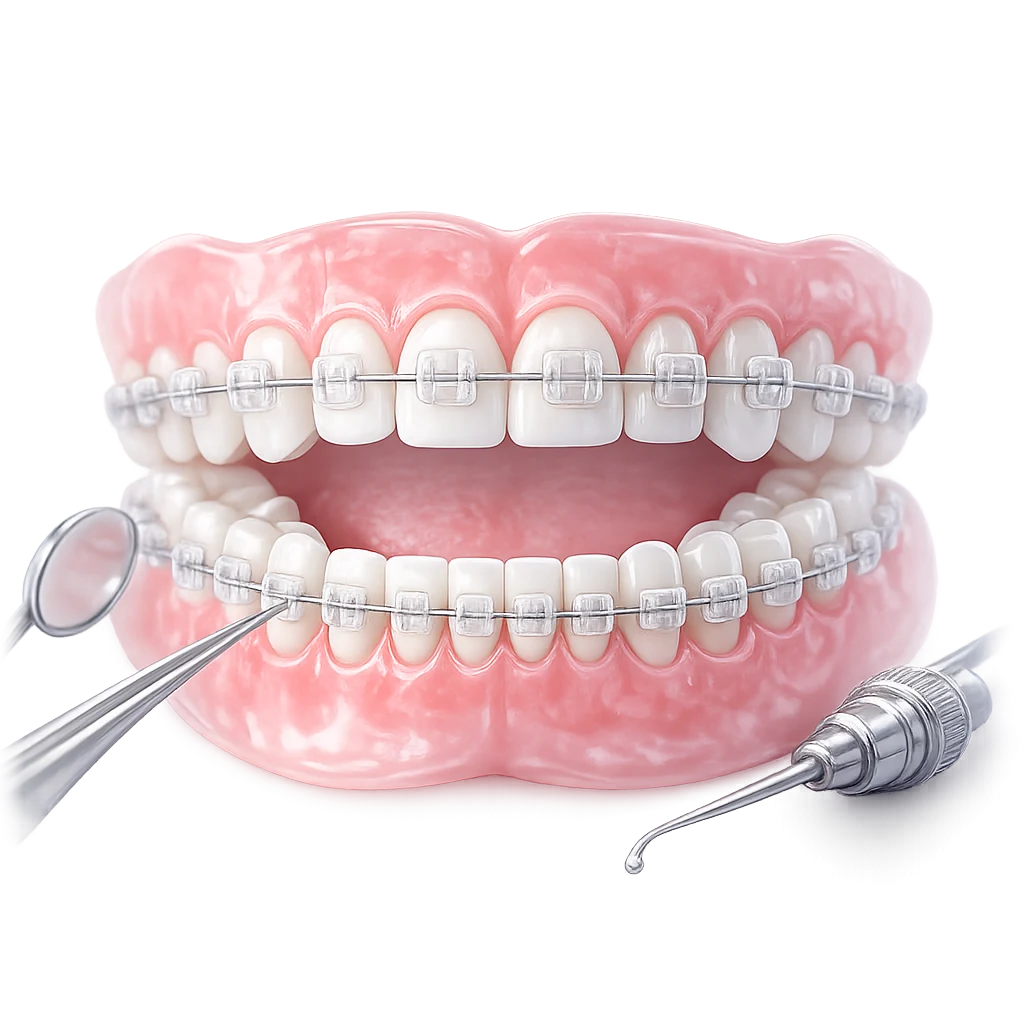

Braces (bracket systems) are orthodontic devices designed to correct bite and tooth position.
In the most general terms, the working principle of bracket systems can be described as follows: brackets are attached to the patient’s teeth and connected to each other by an archwire. The archwire transmits pressure from the brackets to the teeth. Mechanical pressure stimulates bone tissue growth and remodeling, resulting in bite and tooth position correction.
| Ligature braces | |
| Type | Elastic bands (ligatures) are used to secure the archwire |
| Advantages |
– Ease of use: these braces are easier to install, and the elastic bands are easy to replace. – Best adjustment: elastic bands can be replaced or adjusted to control pressure force. – Reliable hold: this bracket system provides the best structural retention |
| Disadvantages |
– Slow correction: additional friction forms between the archwire and elastic bands, increasing discomfort and correction time. – Greater volume: the structure increases in volume due to the elastic bands surrounding the tooth, leading to additional cleaning difficulties and discomfort |
| Self-ligating braces | |
| Type | Clips built into the bracket are used to secure the archwire |
| Advantages |
– Fast correction: this bracket system provides less friction between the archwire and clips, promoting more effective treatment. – Even pressure: the attachment mechanism provides even and continuous pressure |
| Disadvantages |
– Complex installation and adjustment: require more time for installation and extensive experience from the doctor. – High cost: generally more expensive than ligature braces |
Ligature braces are divided into:
- braces with elastic bands (the archwire is secured with elastic bands, which, among other things, allows creating so-called “colored braces” with bands of different colors);
- braces with metal ligatures (the archwire is fixed with metal loops).
Self-ligating braces are divided into:
- braces with locks (have lock mechanisms built directly into the bracket);
- braces with clips, or self-ligating braces (the archwire in the bracket is fixed with clips; self-ligating braces cause less irritation to the mucosa and are easier to get used to).
In recent decades, the use of bracket systems has become common practice, and people wearing braces attract less and less attention in society. However, for a large portion of patients, the aesthetic aspect still matters greatly, for many – also due to their profession. This is why lingual braces, developed in the USA in the late 1970s, are becoming increasingly popular.
| External braces: | |
| Description | Attached to the outer side of the teeth |
| Advantages |
– Effectiveness: provide good controlled pressure. – Price and availability: used in most clinics and have a relatively low cost |
| Disadvantages |
– Aesthetics: these braces are very noticeable, which embarrasses some patients. – Discomfort: often uncomfortable, require adjustment during the initial stages of treatment |
| Internal, or lingual braces: | |
| Description | Attached to the inner side of the teeth |
| Advantages |
– Aesthetics: internal braces are virtually invisible from the outer side of the teeth |
| Disadvantages |
– Discomfort: require a longer adaptation period as they are positioned closer to the tongue, causing tongue irritation. – Hygiene: lingual braces make daily teeth cleaning more difficult |
Material diversity also helps resolve the aesthetic dilemma. Initially, all bracket systems were metal, but ceramic braces began appearing on the market in the 1980s. The ceramic bracket system was developed largely to address aesthetic concerns.
Today, depending on the material, the following types of braces can be distinguished:
- Metal braces.
Typically, metal braces are made of stainless steel. Less commonly, titanium braces are made – for people with increased sensitivity to nickel contained in stainless steel.
| + | – |
|
– strength; – reliability; – relatively low cost |
– aesthetics; – mucosa irritation; – difficulty in care |
- Ceramic braces.
They have the same construction as metal braces but are less noticeable on teeth as they are made of transparent material. The following materials may be used in production:
- polycrystalline zirconium aluminate;
- monocrystalline zirconium oxide;
- aluminum oxide ceramics;
- lithium disilicate ceramics.
All these materials are characterized by sufficiently high strength and transparency, making them the optimal choice for creating less noticeable bracket systems in the mouth.
| + | – |
|
– aesthetics; – comfort; – variety of elastic band colors |
– susceptibility to damage; – may change color under food influence; – high cost |
- Sapphire braces.
Made of transparent material – specially purified sapphire crystals. Sapphire braces are transparent and have the best discretion (invisibility).
| + | – |
|
– aesthetics; – resistance to pigmentation; – variety of elastic band colors |
– fragility; – high cost |
- Plastic braces.
Also transparent braces, made of polymer material (acrylic or polycarbonate plastic) that ensures the bracket system’s invisibility.
| + | – |
|
– aesthetics; – light weight and softness; – variety of elastic band colors |
– fragility; – susceptibility to pigmentation; – increased care requirements |

Extensive experience
Стаж работы челюстно-лицевой хирурга 38 лет, из них 8 лет — работа дежурным врачом отделения острой травмы.

Number of surgeries
Over 2,000 successful surgeries in the field of maxillofacial surgery.

Quality of work
Thanks to a thorough approach in diagnostics and treatment planning for each clinical case, we achieve a minimal number of complications.



- incorrect tooth position.
Teeth straightening with braces is necessary if the patient has pathological tooth overlap or incorrect positioning of an individual tooth, gaps between teeth (diastemas, tremas);
- incorrect bite.
Bite correction with braces is necessary if the patient has an excessively high upper row of teeth (overbite), excessively low upper row of teeth (underbite), upper and lower jaw teeth contact incorrectly, or teeth do not meet in the closed position.
An incorrect bite is not only an aesthetic problem; it also provokes functional problems related to chewing, speech, facial muscle imbalance, headaches, temporomandibular joint function, and gastrointestinal tract;
- pathological tooth wear.
Abrasion (pathological tooth wear) and bruxism also require bite correction with braces to prevent further tooth wear and loss;
- preparation for further treatment.
In some cases, doctors recommend braces as a first step toward further treatment – implant-supported prosthetics or crown installation.
The use of bracket systems is not available to patients who have a number of concurrent medical problems, such as:
- mucosal diseases.
Periodontitis (mucosal inflammation and destruction of the bones supporting the teeth), periapical periodontitis (inflammation of tissues surrounding the tooth), and some other oral diseases make the use of braces impossible;
- breathing or swallowing problems.
In some patients, bracket systems may provoke breathing or swallowing problems. In such cases, orthodontic treatment with braces should be abandoned;
- allergic reactions.
Rarely, but sometimes bracket systems may provoke allergic reactions. In such cases, it is necessary to either change the braces material or abandon the idea of using them in favor of aligners;
- insufficient number of teeth and/or bone tissue deficiency;
- psychological or behavioral problems.
Also, bite correction or teeth straightening with braces should be postponed due to the need for preliminary dental treatment or surgical intervention.

During the preparatory stage, the following is performed:
- examination;
- radiography;
- diagnostic calculations of cephalometric radiograph and diagnostic models of the patient;
- dental and mucosal treatment (if needed);
- surgical intervention (if needed);
- professional teeth cleaning.
During the bracket system installation stage:
- application of adhesive that fixes the brackets to the teeth and bracket installation;
- archwire fixation;
- bracket system adjustment;
- monitoring and check-up (approximately every 4–8 weeks).
During the bracket system removal stage:
- braces removal;
- hygienic cleaning and teeth polishing;
- teeth remineralization;
- fabrication of retention trays, installation of retainers (to maintain the achieved treatment effect).
Using braces on the lower jaw has its own specifics:
- tooth size consideration (lower jaw teeth are often smaller and have a flatter shape);
- breathing and swallowing control (the proximity of the bracket system to the tongue may provoke temporary difficulties with breathing, swallowing, and speaking);
- chewing control (at the beginning of treatment, the bracket system on the lower jaw may complicate chewing – dietary restrictions are recommended for patients);
- safety control (the lower jaw may be less stable, so doctors pay increased attention to checking the quality of bracket system installation).
The total cost of braces consists of two parts: the cost of the braces, components, and the doctor’s fee. Depending on the type, the price of braces may vary.
As expected, sapphire braces are the most expensive for the patient (the average price in Kyiv starts from 30–40 thousand hryvnias per jaw), ceramic braces are slightly cheaper (the average price in Kyiv starts from 25–35 thousand hryvnias per jaw). The most affordable option remains the traditional metal bracket system (the average price in Kyiv starts from 20–25 thousand hryvnias).
It should also be noted that regardless of material, self-ligating braces will cost 7–10 thousand hryvnias more. The final price of braces installation at some clinics may also vary depending on the complexity of cases. Additionally, braces maintenance is paid separately; depending on the type of procedures, each appointment costs the patient 1–2 thousand hryvnias.
Includes: sterile kit, bracket system, bracket system installation
Includes: sterile kit, bracket system, bracket system installation
Includes: sterile kit, bracket system, bracket system installation
It all depends on the type of braces, the method of fixation, and the complexity of the clinical picture, but on average, bracket system installation takes up to two hours.
No. Patients may experience slight discomfort, but there is no pain involved. Typically, anesthesia is not used when installing bracket systems, but in rare cases for patients with increased sensitivity, it may be applied.
Again, it all depends on the specific clinical picture. On average, treatment takes from six months, but in a number of complex cases, it may take a year, two, or even three years.
Here each patient has complete freedom of choice – this is not a medical question. However, we do not recommend our patients use black or red elastic bands. The former – for an obvious reason, and the latter – because they can create an appearance of a bloodied mouth. Many of our patients match their braces elastic bands to their eye color.