Didn’t find the necessary information? Make an appointment for a consultation with oral surgeon Ihor Oleksandrovych Osadchy.

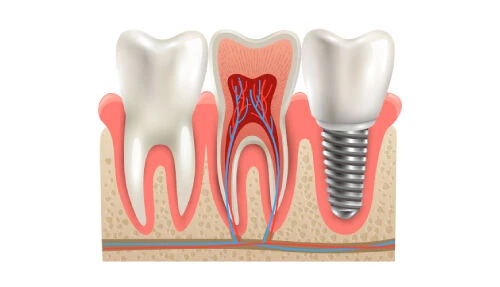
How does tooth implantation occur
Dental implantation is one of the most popular procedures in modern dentistry. Since many patients come to the need of restoring a lost tooth, many questions arise about the procedure itself. In various forms, the following questions are heard: “How does the dental implantation process work?”, “How is a dental implant placed?”, “How is dental implantation performed?” We answer everything in detail and clearly.
Implantation is a surgical procedure during which an artificial tooth root is placed and further prosthetics are performed.
The main goals of implantation include:
- Restoration of chewing function. Tooth loss can greatly complicate the chewing process and lead to digestive problems. Implants allow full restoration of chewing function.
- Aesthetics and self-confidence. Missing teeth can cause feelings of insecurity and lower self-esteem. Implants help create a smile as close to natural as possible, and sometimes even more beautiful.
How dental implantation is performed
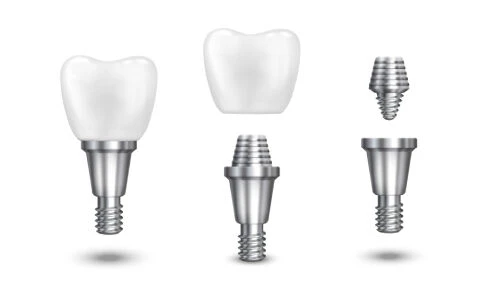
To better understand how tooth implantation is performed, one should first understand the structure of an implant. Implants are needed to replace lost teeth, and structurally they consist of three main parts, each of which, figuratively speaking, replaces one part of the tooth: the root of the lost tooth is replaced by the implant root, the neck by the abutment (connector), and the crown part by an artificial crown.
Having several component parts of the structure opens up possibilities for implementing different scenarios of how a dental implant is placed.
Scenario 1. Single-stage implantation (root, abutment, and temporary crown are placed in one appointment).
Scenario 2. Two-stage implantation (the root is placed at the first appointment, and the abutment and crown at the second).
However, the variety does not end there, so each scenario and its variations should be examined in more detail.
Implantation in any case begins with consultation and preparation. The doctor studies the patient’s medical history, their X-ray, and also conducts an initial examination. Then, based on the information obtained, the doctor concludes which implantation method will be optimal for the patient. Planning and preparation are carried out. This is the general starting point for all implantation techniques, but further options are available.
Suppose that, taking into account the individual clinical picture, the patient’s wishes, and all possible risks, a decision was made to perform single-stage implantation. In this case, the process will be as follows:
- Implantation procedure:
- Anesthesia: local anesthesia.
- Incision and preparation: the doctor makes a small incision in the mucosa to access the bone tissue. A socket is formed in the bone for the implant.
- Implant placement: an artificial root is placed into the prepared socket.
- Abutment placement: an abutment is integrated into the artificial root; in some types of implants, the implant and abutment are a single non-detachable structure.
- Temporary crown placement: a temporary crown is placed on the abutment.
Note that the temporary crown placement can be with immediate loading (the patient can already chew on the artificial tooth) or without it (the crown is taken out of occlusion to ensure better implant integration).
- Postoperative period:
- Care recommendations: the doctor gives the patient instructions for oral care.
- Follow-up visits: the patient should regularly visit the dentist to monitor the implant condition and tissue healing.
- Osseointegration:
- Healing process: over several months (usually 3-6), the implant integrates with the bone, meaning that the bone heals well around the placed implant.
- Permanent crown placement:
- Crown fabrication: after successful osseointegration, a permanent crown is fabricated considering color and shape.
- Crown placement: the permanent crown is attached to the abutment, completing the implantation process.
- Monitoring and care:
- Regular check-ups: the patient needs to periodically visit the dentist to monitor the implant and crown condition.
- Hygiene: it is important to maintain good oral hygiene to avoid inflammation and infections around the implant.
Two-stage implantation takes more time but has a better prognosis and significantly lower risks of implant rejection. Note that two-stage implantation does not involve immediate loading. After consultation and planning, the implantation process proceeds as follows:
- First surgical procedure:
- Anesthesia: local anesthesia.
- Incision and preparation: the doctor makes a small incision in the mucosa to access the bone tissue. A socket is formed in the bone for the implant.
- Implant placement: an artificial root is placed into the prepared socket.
- Suturing: the artificial root is sutured until the osseointegration process is complete.
- Second surgical procedure:
- Implant exposure: after successful osseointegration, the surgeon makes a small incision in the mucosa to expose the upper part of the implant.
- Healing abutment placement: a special cap (healing abutment) is placed on the implant, which helps the mucosa heal and form the correct contour for the future crown.
- Taking impressions:
- Removing the healing abutment.
- Placing the transfer.
- Taking the impression: the doctor takes an impression of the teeth for fabricating an individual crown; either impression material or an intraoral scanner may be used.
- Removing the transfer and placing the healing abutment.
- Transferring impressions and information about the type, material, shape, and color of the future crown to the dental laboratory.
- Abutment and crown placement:
- Removing the healing abutment.
- Placing the abutment.
- Crown placement: after fabrication, the crown is placed on the abutment. The crown can be temporary or permanent.
- Monitoring and care:
- Regular check-ups: the patient needs to regularly visit the dentist to monitor the implant and crown condition.
- Hygiene: it is important to maintain good oral hygiene to avoid inflammation and infections around the implant.
When talking about how dental implantation is done, it is impossible not to mention the immediate technique. Its distinctive feature is that implantation takes place immediately after tooth extraction — in one appointment.
That is, the doctor first performs tooth extraction, and then integrates an artificial root — an implant — into the socket formed after removal. At the same time, immediate implantation can be either single-stage or two-stage.
Anxiety is a natural reaction of the body. Some people experience it more, others less. We recommend all patients without exception to eat before the procedure, as this helps reduce adrenaline levels. Furthermore, if the patient feels strong anxiety, we perform premedication directly at the clinic — we use special sedative medications that do not affect the course of the operation, the ability to drive, or attention, but calm the patient.
Unfortunately, no. Determining bone quality (understanding its density and the ratio of cancellous and cortical layers) is only possible by flap elevation directly during the surgical procedure. CT can only give us rather approximate information specifically about bone tissue quality.
If during tooth extraction the doctor discovers an inflammatory process, then immediate implantation is not possible. After extraction, the doctor performs debridement and prepares the bone for delayed implantation. Depending on the clinical picture, implantation due to inflammatory processes may be postponed for a period of two weeks to two months.

Igor Osadchiy
Surgeon
MD, physician with the highest skill accreditation level, member of EACMS (European Association of Cranio-Maxillofacial Surgeons), member of the Association of Implantologists of Ukraine. Alma mater: O.O. Bogomolets National Medical University. Year of graduation: 1984. Experience: Work experience: 38 years. For 13 years (1985-1998), taught dental surgery and maxillofacial surgery…
Igor Osadchiy
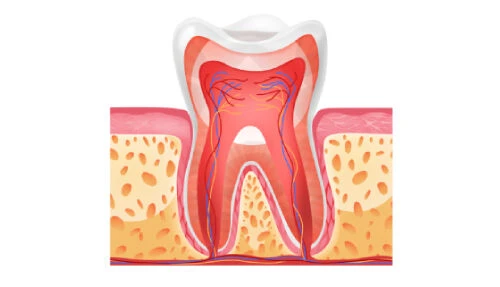
Treatment of tooth nerve inflammation
04.02.2025
Despite the fact that dental procedures have become significantly less painful over the past few decades, not all patients visit the dentist on time. Often fears prevail over health needs. This is confirmed by the statistics of cases of such a disease as pulpitis, especially irreversible. In Kyiv, two out of ten patients come to the dentist complaining that their tooth nerves have become inflamed due to long-untreated caries.
Igor Osadchiy
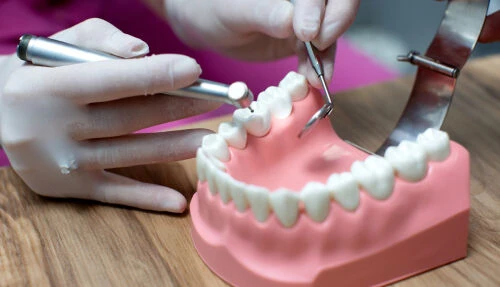
Installation of a dental crown
03.02.2025
Installing dental crowns is an important dental procedure designed to restore the functionality and aesthetics of teeth. It may be necessary in cases of significant tooth damage, after caries treatment, due to trauma, or certain bite pathologies. There are many types of dental crowns that need to be carefully considered before making a decision.
Igor Osadchiy
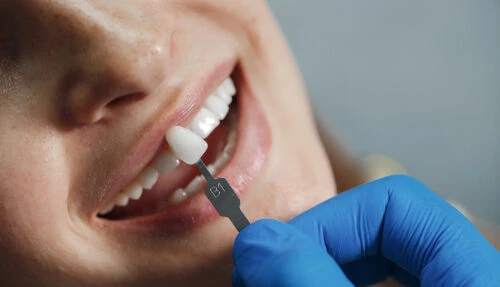
Installation of a crown on an implant
03.02.2025
No patient visits a dental clinic for an implant, and they are not even interested in implantation as a service. Patients mostly need to restore a lost tooth, which means they need not only an artificial tooth root but also prosthetics — most often with a crown. The range of variations here is quite wide, which in turn affects both the price of the implant crown and the cost of the procedure.
Igor Osadchiy
Gingivitis
23.01.2025
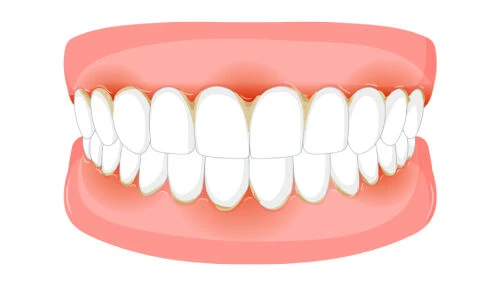
Gum disease (gingivitis) is a common problem faced by many dental clinics in Kyiv and Ukraine. Patients sometimes think that sensitivity and redness of the mucous membrane is a minor issue. However, one should remember about complications. Gingivitis has quite a few of them, so it is important to visit a clinic in time to eliminate the inflammatory process at an early stage.
Igor Osadchiy
Treatment of dental canals
23.01.2025
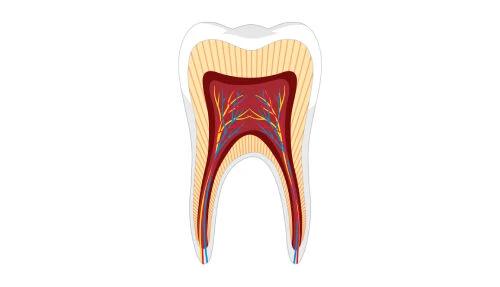
The vast majority of clinics in Ukraine provide endodontic services, and almost every adult patient has faced the need for nerve removal and root canal filling. Endodontic treatment is a fairly large field with a number of important nuances that patients should be aware of.

Igor Osadchiy
Jaw fracture
23.01.2025
Accidents, falls, and other situations that lead to injuries unfortunately do happen. Sometimes their consequence is a jaw fracture. It is important to note that patients cannot always understand that they have sustained a fracture, while successful rehabilitation directly depends on the speed of seeking medical help.
Igor Osadchiy
Teeth splinting
22.01.2025
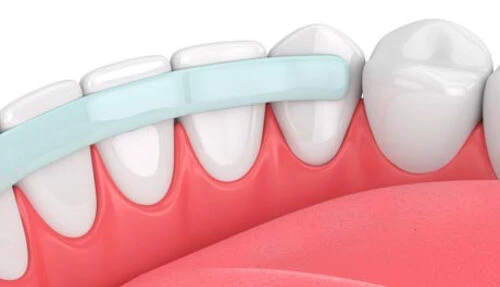
Many clinics in Kyiv offer teeth splinting as a treatment method, including for periodontal teeth. The danger of such manipulations is extremely high. We believe that patients should weigh the risks, and for this, they need to better understand the essence and purpose of such a medical procedure as teeth splinting.
Igor Osadchiy
Depulped tooth
20.01.2025
Endodontic treatment involving tooth devitalization has gained great popularity. It is now difficult to find an adult who has not had a nerve removed in at least one tooth. At the same time, many patients have doubts and do not always decide on depulpation, thereby condemning themselves to tooth extraction. So what is a depulped tooth and how does endodontic treatment work?
Igor Osadchiy
How a dental implant is placed
20.01.2025
Almost every dental clinic in Kyiv and Ukraine can easily compile its own top list of topics that interest patients who have decided to get an implant. At Osadchyi Dental Clinic, we answer all questions in detail and provide consultations. However, many people want to receive information even before their consultation, so we decided to briefly go through the key points that are in the focus of patients’ attention.

Igor Osadchiy
White coating after tooth extraction
16.01.2025
Almost every dentist has encountered queries like: gums turned white after tooth extraction, pulled a tooth and there is a white pouch on the gums, something white and soft in the socket after tooth extraction, or white spots on the gums after tooth extraction. We want to reassure all patients: everything is fine, there is no cause for concern.
Igor Osadchiy
Is it painful to remove stitches after a tooth extraction
16.01.2025
21st-century dentistry allows performing very complex manipulations and operations absolutely painlessly for the patient. However, many people still experience fears associated with visiting a dental clinic. In particular, there is a whole cluster of questions related to sutures: Does it hurt to remove sutures after tooth extraction? Does it hurt to remove sutures from the gums after wisdom tooth extraction? How long after tooth extraction are sutures removed? What happens if sutures are not removed after wisdom tooth extraction?